Friday, January 18, 2008

MLK, Jr. Day - Day of Service

What is the best way to honor the legacy of the Rev. Dr. Martin Luther King? How would the civil rights leader, activist and clergyman want people to remember him?

In 1994, the United States Congress answered that question when it passed the King Holiday and Service Act, designating the third Monday in January as a national Day of Service. The Act asked
Americans to see the day not just as time off from work or school, but as an opportunity to honor King’s legacy by taking part in community service projects. In short, they were asked to “make it a day on, not a day off.”

On January 21, 2008 millions of Americans across the country — including many Episcopalians -- will conduct food drives, paint schools and community centers, recruit mentors for needy youth, and bring meals to homebound neighbors, among many other projects. For 2008, in recognition of the 40th anniversary of Dr. King’s death, the Corporation for National Community Service, a government agency charged with carrying out the service aspect of MLK Day, has announced a new initiative: “40 Days of Nonviolence: Building the Beloved Community.”

This year, King Day of Service will kick off 40 days during which families, schools, faith communities, and other organizations will plan service projects and educational activities promoting Dr. King’s message of nonviolence and social justice. (For more information, visit www.mlkday.gov/about/beloved_community.)

The King Day of Service brings together people who might not ordinarily meet, breaks down barriers, leads to better understanding and ongoing relationships, and gives organizations an opportunity to recruit new volunteers for their work. Participation in the King Day of Service has grown steadily over the past decade, with hundreds of thousands of Americans each year engaging in projects. Episcopal congregations throughout the nation will take part this year in the Day of Service, many of them in cooperation with other churches and community organizations.

Information and photos from the Corporation for National Community Service. (from Episcopal News Service]

***************************

Sunday, January 20, 4 – 6 pm
17th annual Dr. Martin Luther King, Jr. Birthday
Commemoration of Litchfield County
Trinity Episcopal Church, Torrington
Speakers include Dr. Bernard LaFayette, Jr., director, Center
For Nonviolence and Peace Studies, University of Rhode
Island. Sankofa Kuumba Dancers and Drummers and Peace
is Possible Chorus. Cosponsored by Connecticut Center
for Nonviolence (www.ctnonviolence.org) and Community
Foundation of Northwest Connecticut.

**************************

Almighty God, by the hand of Moses your servant you led your people out of slavery, and made them free at last; Grant that your Church, following the example of your prophet Martin Luther King, may resist oppression in the name of your love, and may secure for all your children the blessed liberty of the Gospel of Jesus Christ; who lives and reigns with you and the Holy Spirit, one God, now and for ever. Amen.

Week of Prayer for Christian Unity

The Week of Prayer for Christian Unity is celebrated annually in January between the feast of the Confession of St Peter (Jan. 18) and of the Conversion of St Paul (Jan. 25), the Week of Prayer for Christian Unity is another way in which Christians around the world remember one another in prayer.

Lord Jesus, you prayed that your disciples might be united with each other, in a unity grounded in your oneness with the Father and the Holy Spirit. May your prayer for unity grow in the depths of the hearts and minds of all Christians and especially those gathered in the churches of Monroe. May we be one in our words, that a single reverent prayer might rise before you; may we be one in our yearning and pursuit of justice; may we be one in love, serving you by serving the least of our sisters and brothers. Lord, make us one in you. Amen.

(adapted from a prayer by Mgr. Donald Bolen)


Confession of Saint Peter - January 18

Almighty Father, who inspired Saint Peter, first among the apostles, to confess Jesus as Messiah and Son of the living God: Keep your Church steadfast upon the rock of this faith, so that in unity and peace we may proclaim the one truth and follow the one Lord, our Savior Jesus Christ; who lives and reigns with you and the Holy Spirit, one God, now and for ever. Amen.

Sermon: Baptism of Jesus

Here is my servant, whom I uphold,
my chosen, in whom my soul delights;

The baby Jesus of last week who was manifested to the gentiles on the feast of the Epiphany, has become the adult who was manifested again, this time at the River Jordan with John the Baptist. John at first refuses to baptize Jesus, recognizing the Son of God before him, but consents when Jesus asks him to do it and John baptizes Jesus. Jesus who was born as one of us, who was baptized as one of us, invites us to see these events not as voyeurs looking on from afar as if these events have no real meaning for us, but to see them connected to our own lives, when God was present with us, in birth, in baptism…

Think of that baptismal moment when Jesus was baptized, the intimate connection of the Trinity. The voice of God the Father speaks, the Spirit descends like a dove as Jesus rises out of his baptismal waters, this is my son the beloved, with whom I am well pleased. No matter what your age, no matter how or when it happened, on your baptismal day, the God who had knit you together in your mother’s womb, proclaimed God’s love for you on that baptismal day. When your parents and godparents named you before God in baptism, the Spirit came upon you at your baptism and indeed God was well pleased! And on that day, you were sealed by the Holy Spirit in baptism and marked as Christ’s own forever.

The season of Epiphany, of Christ made manifest to us and the world as the Son of God, is also the season of invitation to make Christ’s life manifested in us. As Evelyn Underhill put it, “The first point about Epiphany is that all are called and welcomed and accepted. Our own adoration and deep certitude, if God in his mercy gives us that, is never to break our brotherhood with those who come longer journeys by other paths.”

The story of Jesus baptism is laced with the words of Isaiah. The servant of the Lord, whom we heard about in the first reading. The servant of the Lord, brings forth justice, opens the eyes of the blind, and brings out prisoners from the dungeon, sharing the light with those who sit in darkness. This is our baptismal calling. This is the path that Jesus took. This is the path that the Spirit of God leads us on to make him manifest in our lives.

So how have we been God’s servant? Promoting justice, sharing that light and love with this world that so badly needs it. With war and terrorism, with threats and finger-pointing, with a slow economy and lay-offs abounding, it seems that times couldn’t be worse. Now is the time for us, with the authority of our baptism to speak in God’s name, to live as Jesus has showed us and to know that we are loved by our God. For as we are marked as Christ’s own forever, we are reminded on this celebration of Jesus baptism, to recommit ourselves to the meaning of our baptism, to live out the Good News of Jesus in our lives.

I am reminded of the movie The Apostle starring Robert DuVall. Duvall portrayed 'Sonny', a traveling evangelist, who grew up attending African American church services, absorbing their spirit to make him a persuasive preacher despite his sins. After he leaves town because of an altercation, he prays that God will call him to a new ministry. At a lake on the way, he rebaptises himself, takes on a new name and moves on to begin his new ministry in Louisiana. What strikes me about the movie and the character, is that as he starts over again, he wants to start off right, so he rededicates himself to God, rebaptizing himself in that river and goes about his way.

Every year after the hustle and bustle of the holidays are over and we begin a new year, we stop and remember the baptism of Jesus and recall our own baptisms even if we don’t remember them. And as we stop today, we are called to renew that baptismal calling that is inside of us, not by being baptized again, but by recalling the words of our baptism, and trying to live out those baptismal vows in our lives as followers of Jesus. In just a moment we will renew our baptismal vows, but it is more than that simple act, we are also invited to live the vows out in our lives…

By taking part in the Eucharist, in the breaking of bread, in the prayers, to resist the evil all around us, and repent and return to the Lord when we sin. Through our lives by word and example, we are called to proclaim the Good News of God in Christ, to seek and serve Christ in all persons, loving our neighbors as ourselves and we need to strive for justice and peace and respect the dignity of every human being. That is how we start today to live out of our baptism, of following Christ, of helping to make Christ manifest in our lives and others…

I know of a college graduate who was looking to do something meaningful with her life when she found out about the Peace Corps. She now teaches English in Mozambique. A fellow priest heard about a need for chaplains, and became an army chaplain and has just finished his first deployment to Afghanistan.

Every evening on her way home, an elementary school science teacher passed a launderette. The scene was always the same: While parents did the mountains of laundry, their kids played video games, stared at the laundry’s television, raced around the long narrow aisle playing bumper carts until a mom finally had enough. Like every inner-city educator, this teacher’s biggest challenge was getting students interested in reading outside the classroom. What she saw at the launderette sparked an idea. With the enthusiastic help of the launderette owner, the teacher gathered a collection of 50 books — ABCs, picture books, books on science, books that had everything to do with fun. Just before the “after dinner rush” at the launderette, she set up the books on tables provided by the owner. The surprised parents had never seen their children talking so animatedly about books before. One night, one of the library “regulars,” came running up to the teacher. With a huge smile, she announced, “I remembered the words you helped me with last night!” and spelled the four words that they worked on the night before. The happy little girl hugged the teacher. [From “Home work cycle” by Georgina Smith, Guideposts, September 2006.]

Each embraced the calling that they heard, each are living out their baptisms. As one author put it: “Today’s Gospel proclaims that there is one important thing…to hear the voice that says “this is my child, the beloved with whom I am well pleased” as underlying the whole of life.

To live out your life in this identity is the calling each one of us has.” Indeed, may we all hear that voice too from Isaiah:

Here is my servant, whom I uphold,
my chosen, in whom my soul delights;

Today our ministry begins anew. Amen.

Sunday, January 6, 2008

The Win-Win Episcopal Buckeye/Tiger Challenge

(from the Episcopal Diocese of Southern Ohio)

More than two years ago, Hurricane Katrina and subsequent flooding devastated New Orleans and the Gulf Coast. On Jan. 7, 2008, the Ohio State University Buckeyes will take on the Louisiana State University Tigers in the same stadium that offered refuge in the days following the hurricane.

Today, thousands of people still are homeless. The people of New Orleans need our help. Bishop Breidenthal asks the people of Southern Ohio to join him in this win-win challenge. Make a pledge now to donate to the Diocese of Louisiana each time the Buckeyes score. It’s a win for OSU fans -- and a win for New Orleans.

Louisiana Bishop Charles Jenkins welcomes the assistance from Southern Ohio.

"I wholeheartedly accept Bishop Breidenthal’s generous challenge, although I am concerned that the Buckeye fans won’t have to buy very many Bundles of Hope. We know they will have a hard time scoring against the Tiger defense," he says. "We truly appreciate the volunteers and the donations from the Diocese of Southern Ohio, and we are grateful for the help in rebuilding New Orleans."

The Episcopal Diocese of Louisiana has established a program for supporting the recovery effort called “Bundles of Hope.” A $20 donation buys a Bundle of Food, while a $50 donation buys a Bundle of Care, helping provide wellness and medical care. The bundles are available at $100, $250 and $1000 levels of giving as well. Visit Bundles of Hope at www.edola.org/bundlesofhope.php to learn more.

How to help: (anyone can join in)

• You decide how much you want to pledge (i.e.: a bundle of food or care for each touchdown or field goal).

• After the game, donate safely and securely online at www.edola.org/bundlesofhope.php
or send your check directly to the Diocese of Louisiana at

Episcopal Diocese of Louisiana
P.O. Box 5026
Baton Rouge , LA 70821

********************

I am taking up the challenge, BUT, as you can see I changed it a bit...

I will be pledging for the LSU Tigers. Go Tigers!

Take up the Bishop's challenge!

Epiphany Sermon

Merry Christmas, Happy Epiphany!

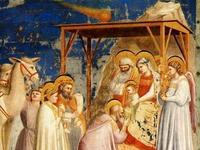
If you weren’t in Church today, you would think I was crazy for saying such things, but today is the last day of Christmas as we celebrate the Epiphany, the arrival of the three kings at the manger, El Dia de los Reyes. Most of our country has sadly, forgotten about the 12 days of Christmas and its ending with Epiphany, stores are already stocking up for Valentines Day. Thankfully the Church and the Latin American culture that is present here remembers los Tres Reyes, the three kings and their presence in the Nativity.

We know from the Gospel of Matthew that wise men from the east (Gk. Magi) came looking for the baby Jesus following a star. King Herod is frightened that they are looking for a baby born “King of the Jews”… The wise men, leaving Herod, continue to follow the star and find Jesus with Mary and pay him homage and offer their gifts of gold, frankincense and myrrh. They are warned in a dream not to return to Herod so they return home by another road.

Later tradition says there were three wise men or three kings because there were three gifts, and the names of Gaspar, Balthasar and Melchior gets attached to them. The gifts they offer, recognizing Jesus and in anticipation of his life, are symbolic with gold for a king, frankincense for the son of God and myrrh for his death as a human being. But those were not the only gifts. The birth of Jesus was a gift not only to the Jewish people but to the world. His manifestation to the wise men, symbolically reminds us that this gift was to be shared with the world, for the light of God has come into the world. And it is up to us in our lives to share that gift, of the light that has come into darkness…

One gift I got this past week was to watch a lot of football. After Michigan beat Florida (Go Blue!), I was in a great mood. As I watched USC dismantle Illinois in the Rose Bowl, I heard the announcers talk about an article on the coach of the USC Trojans, Pete Carroll. Pete Carroll has built USC into a college football powerhouse but he does not keep himself locked up on the beautiful grounds of USC. At night, some times you can find him in the rough parts of LA…

This is from an article in LA Magazine… (you can find the article online here.)

"They (Pete Carroll and Bo Taylor) make late-night journeys through the dicey precincts of Los Angeles. Alone, unarmed, they cruise the desolate, impoverished, crime-ridden streets, meeting as many people (mostly young men) as possible. The mission: Let them know that someone busy, someone famous, someone well known for winning, is thinking about them, rooting for them. The young men have hard stories, grim stories, about their everyday lives, and at the very least Carroll’s visit gives them a different story to tell tomorrow. Carroll says: “Somebody they would never think would come to them and care about them and worry about them—did. I think it gives them hope."

And its not just a one time visit…

"A young man stops Carroll, takes the coach aside and becomes emotional while explaining how much this visit has meant to him. He gives Carroll a bracelet, something he made, a symbol of brotherhood and solidarity. Carroll accepts the bracelet as if it were a Rolex. He’ll wear it for days, often pushing back his sleeve to admire and play with it. He gives several young men his cell phone number and tells them to call if they ever need to talk. One, an ex-con, will call early the next morning and confide in Carroll about his struggles feeding his family. Carroll will vow to help find him a job. (So far, Taylor said, Carroll has found part-time jobs for 40 young men.) "

from 23 Reasons Why A Profile of Pete Carroll Does Not Appear in this Space in Los Angeles Magazine By J.R. Moehringer

That is bringing the gift of light into darkness, of taking his coaching to an all new level and indeed bringing hope into dark places. He used his gift of coaching to reach a whole different segment of the population. Indeed we are called to bring our gifts, to celebrate once again at the manger, but to go out and offer our gifts to a world in need, like Coach Carroll. We must not tarry too long or we might miss our chance.

And that is the story of Befana, an Epiphany legend…

Befana the Housewife, scrubbing her pane,
Saw three old sages ride down the lane,
Saw three gray travelers pass her door -
Gaspar, Balthazar, Melchior.

"Where journey you, sirs?" she asked of them.
Balthazar answered, "To Bethlehem,
For we have news of a marvelous thing.
Born in a stable is Christ the King."

"Give Him my welcome!"
Then Gaspar smiled,
"Come with us, mistress, to greet the Child."

"Oh, happily, happily would I fare,
Were my dusting through and I'd polished the stair."

Old Melchior leaned on his saddle horn.
"Then send but a gift to the small Newborn."

"Oh, gladly, gladly I'd send Him one,
Were the hearthstone swept and my weaving done.

"As soon as ever I've baked my bread,
I'll fetch Him a pillow for His head,
And a coverlet too," Befana said.

"When the rooms are aired and the linen dry,
I'll look at the Babe."
But the Three rode by.

She worked for a day and a night and a day,
Then, gifts in her hands, took up her way.
But she never could find where the Christ Child lay.

And still she wanders at Christmastide,
Houseless, whose house was all her pride,
Whose heart was tardy, whose gifts were late;
Wanders, and knocks at every gate,

Crying, "Good people, the bells begin!
Put off your toiling and let love in."

(Befana by Phyllis McGinley )


The kings have come, the gifts given, and we are invited to again celebrate the gift of the Christ child, to offer our gifts, our hearts again at the crèche. But as we celebrate this day, and leave here in awe and wonder for the gift given to us, the light that has entered the world, let us in turn share our gifts and help spread that light in the darkness today.

Let us pray.

Light of the world, we bow before You in awe and adoration. Bless us and our simple faith seeking understanding. Epiphany means manifestation, lifting the veil, revelation. Reveal to us then what we need to know to love You, and serve You, and keep Your word with fidelity and truth, courage and hope, this day and always. Amen. (prayer by Miriam Therese Winter)

Friday, January 4, 2008

Christmas Sermon

This is the sermon I gave at 10 PM on Christmas Eve.

Leaving Lucy’s Psychiatrist’s stand, Charlie Brown still doesn’t feel like he understands Christmas. He’s not really happy… On the way he walks by Snoopy’s dog house, who was decorating his doghouse with heaps of shiny ornaments. "What's going on here?" Charlie Brown asked. Snoopy showed him a flyer.

Find the true meaning of Christmas. Win MONEY, MONEY, MONEY. Enter the Christmas lights and display contest!

"My own dog has gone commercial," Charlie Brown wailed. "I can't stand it!"

With our news focused on whether or not retailers will have a good Christmas shopping season, these words uttered by Charlie Brown some 42 years ago, ring true today. For some, Christmas is about money, about stuff (material things).

We are gathered here tonight, not to avoid the commercialization of the holiday, but to focus once again on the true meaning of Christmas, what it means for our lives, and to grab hold of that joy we want deep down in our souls. Think of our opening hymn:

O come, all ye faithful,
Joyful and triumphant,
O come ye, O come ye to Bethlehem;
Come and behold him,
Born the King of angels:
O come, let us adore him, Christ the Lord!

This is what we are doing here tonight. As faithful pilgrims on our journey, we come once again to St. Peter’s to put ourselves in Bethlehem, to celebrate with joy and behold that Christ the Lord has been born for us. We commemorate Jesus’ birth, bring out the party hats, and enjoy this wonderful gift God has given to us.

But too much of our joy is spent on buying things, or on winning (as Snoopy was trying to do) and too little is spent with each other, loving each other and giving thanks to God for it all. This was not always true. Some of our forebears, especially in New England did not care for some traditions of Christmas and fines were levied by the Puritans on those who kept Christmas. This happened for over a century in some parts of this region, to keep down the revelry, the celebrations, the wassailing…

Its hard to imagine such a strict observance for Episcopalians…

But now we have gone to the other extreme, and we are bombarded by Christmas since Thanksgiving with the busiest shopping day of the year becoming a national holiday. As one author, Bill McKibben put it, “We were Christians, and we felt that the story of the birth of this small baby who would become our Savior, a story that should be full of giddy joy, could hardly break through to our hearts amid all of the rush and fuss of the season.”

Christmas now is so full of fuss and rush, focused solely on the gifts given one day, and we are gorged on carols and everything Christmas, before we even get to Christmas and the 12 days following which are meant to sustain us throughout the year. For Christmas is not just about gifts, and family and food, although for Christians this is one of our big celebrations, and we are meant to enjoy it. But God did not send his son to us so that we could have one day filled with presents, food and fun and forget about it the next day (unless we are returning those presents) and then we get on with our lives. This is not about the stuff the world wants us to buy, which ultimately do not satisfy us. It is about what sustains us, what is lasting in our lives.

God’s son is born to us this night to show us how to live, how to be sustained by God’s love. The message of God this night to the lowly shepherds on the hillside is also the message to us. “Don’t be afraid, I bring you good news of great joy, to you is born this day in the City of David a Savior, who is the messiah, the Lord.”

As Martin Luther put it nearly 500 years ago: “The true Christian religion...does not begin at the top, it begins at the bottom. You must run directly to the manger and the mother's womb, embrace this Infant and Virgin's Child in your arms, and look at Him - born, being nursed, growing up, going about in human society, teaching, dying, rising again, ascending above all the heavens and having authority over all things.”

Our challenge in the hustle and bustle is to remember that God has given us the gift of life and loves us so much that his son is born to us to share that love and to help us in our lives find that joy we long for. For, "Christmas is a time for enormous celebration, but also a time for pondering, for reverence, for awe at our sheer good fortune that God sent His only child into our midst." (McKibben)

All of our Advent preparations have lead us to tonight. So let us celebrate Christmas and begin anew our Christmas journey so that we celebrate life each day. May the message of the angels enter our hearts and may we live it in our lives. For this is a gift we carry all our days if we are really willing to let Christmas not be just one day, but to enter our hearts.

For what we all want is joy, and we want "to emerge from Christmas relaxed, contented, happy to have kept this season. To emerge closer to our family than when Advent began. To emerge with some real sense that Christ has come into our world." (B. McKibben)

Indeed, for “unto us is born this day in the City of David a Savior, who is the messiah, the Lord.” Amen

The Epiphany

The Feast of the Epiphany
January 6th


Some Christians are grateful for the feast of the Epiphany ('the manifestation (epiphaneia) of Christ to the gentiles') on 6 January each year because it offers a second-bite at the greeting card cherry: any number of Christmas cards carry the familiar Three Kings as the artwork, and if not posted by December 25th, they won't look at all out of place in early January. Indeed, it may even imply a certain textual and theological superiority on the part of the sender.

The cameo by the magi - the 'wise men' - in Matthews infancy story (2:1-12) has been encrusted over time with many well-intentioned details, not least of which is the confident ascribing of the number 'three' (not mentioned by Matthew); their status as 'kings' (Tertullian called them fere reges, 'almost kings'); and even names (Gaspar, Melchoir, and Balthasar, which monikers arose spontaneously in the sixth century).

Their fame lives on, and they are recurring stars (no pun here) of stage, screen and Sunday School tableaux, where many a bed sheet has been sacrificed in their honour.

From William Wyler's Ben Hur (1959), to Catharine Hardwicke's The Nativity Story (2006), there is no telling of the birth of Jesus without these three, to whose enduring memory everything from incense to playing cards to a very pleasant pub in Clerkenwell, London, has been named.

But what does Epiphany mean?

At very least, it seems to me that Matthew's take-home message is that God has had enough of the barriers which divide, and that God's passion is - and always has been - for the world.

Matthew's artfully structured story makes great good sense when it is re-read/re-told in the light of the dramatic epilogue to this gospel, the so called Great Commission. In the Epiphany, cast as it is in the opening scenes of Matthew's Gospel, the infant Jesus is revealed to a select but representative group of outsiders: 'the nations' have come to light that God has focused in the pinpoint of one truly human life. When the curtain comes down, the risen Jesus turns the inside out with the command to go and make disciples of 'all nations'.

Whether or not there were three, four, or any number of Magi (Matthew's Greek plural); and no matter their assumed status as professional astrologers , interpreters of dreams, and masters of secret arts; whether they were high-born or self-made of peasant stock, the walls began to crumble. And woe to those who seek to re-build them - a thread which runs through Matthew's telling - to keep out those whom God is letting in.

What became of these strange 'almost kings' after their privileged moments in the light, and their dangerous audience with Herod? With no apparent regard for a good ending, the storyteller simply sends them home - but with the broadest hint that things are different now. The walls are down....

Article from: The Perth Diocesan Magazine - by The Rt Revd Mark Burton - Bishop of Perth, Northern Region, Anglican Church of Australia