Friday, May 15, 2020

On the Spirituality of Quarantine


 from christiancentury.org by M. Craig Barnes May 8, 2020

How can we be “witnesses to the ends of the earth” right now? I have found some help from St. Benedict and St. Gregory.


I am still trying to figure out the spirituality of staying home. When a highly communicable virus is spreading among us, the most loving way to treat our neighbor is through physical distance. And this doesn’t stop the work of the church. I am so grateful to the pastoral leaders on our seminary campus who have found a way to continue chapel services online, offer pastoral counseling over the phone, and mobilize a pastoral care team to check on students. Across the country, pastors are delivering sermons online and hosting digital worship services from their living rooms.

All of that is faithful spirituality. But how do we best fulfill our mission to be Christ’s “witnesses to the ends of the earth” by cloistering ourselves at home?

I have found help with this question by remembering the contributions of St. Benedict and St. Gregory. This is not the first time in human history that we have faced widespread disease that leads us to prayer.

The sixth century was a long, horrible time in Rome. The city had long fallen to a succession of invading armies. The economy was in shambles. And the Plague of Justinian was ravaging the city. People were frightened for so many reasons. But it was also the century that gave us St. Benedict, who wrote the rule that still guides many monastic houses to this day. This rule included a daily rhythm of prayer, work, and the singing of the psalter—including the psalms of lament. Down through the centuries, and the succession of plagues to follow, the people took comfort in knowing that the monks were voicing their laments and petitions to God.

The sixth century also gave us St. Gregory, who reluctantly left one of those monastic houses to become the pope. Not only did Gregory take over the ecclesiastical leadership of the church, but he also sold church property in order to feed the people of Rome. He called himself “a contemplative condemned to action.” But his “action” entailed a careful balance of caring for the poor and developing a theology of prayer for the monasteries. In other words, Gregory saw cloistered prayer as an active way of caring for the world.

The monks weren’t trying to escape the problems of the world. They brought society’s pathos with them into the monasteries in order to devote themselves to a life of prayer for the world’s salvation. Gregory wrote that our prayers begin with humility over the “agitation of the world” we cannot resolve. Staying in prayer, he claimed, leads us into contemplation, which then leads to visions of the goodness of God. And this vision of the Savior with us leaves us with humility in gratitude. So the journey of prayer is from humility in agitation to humility in gratitude.

These days the agitation of the world is ever present before us. People are being hurt physically, emotionally, and economically by this virus. We’re separated from each other, and our virtual communications and classrooms are only virtually satisfying. Even our leaders have more questions than answers, and it is not clear how long this will last. This has come upon us so fast that every week we become nostalgic for the previous one. Yes, we have been humbled by this virus. And Gregory would say that is a call to prayer for the world.

To be clear, his point is not that we might as well pray if we have nothing else to do while stuck at home. His ministry is a testimony that our prayers in humility are also a means of activism. We join 1,500 years of cloistered monks who brought the world’s laments before God in search of a vision of salvation. It’s hard to think of anything more effective than placing a sick world back in the arms of its creator and healer.

Through prayer, we demonstrate our resolve not to flee the dangerous virus and hide at home, but to turn those homes into monastic cells that actively call for God’s salvation to find its way to the ends of the earth. These are prayers not just for our family, our community, and our neighbors but for the world. The whole world needs our prayers for holy intervention today.

If we stay in prayer long enough, Gregory promises, we will find the vision we need that today is not the end of the story because a savior is still at work. The God who was so clearly faithful in our past is going to be faithful today, tomorrow, and through eternity. And then we are led to humility in gratitude that God is with us.

But remember, the monks engaged in this journey through prayer as a daily routine. Don’t be dismayed if after getting a glimpse of hope you find yourself again humbled in agitation. That’s a daily invitation to prayer. And along the way you will keep seeing ways God is at work today, which leads back again to humility in gratitude.

I am grateful for glimpses of God’s salvation through the heroism of health-care workers who tirelessly put themselves in harm’s way by caring for the sick. I’m grateful for the leaders around the world who have made hard choices to put human lives above tax revenues and public convenience. And I’m so grateful to the faculty, students, and staff of our seminary who are doing whatever it takes to ensure we are still a high-functioning, loving community of faith and scholarship.

And when anxiety and agitation come knocking the next day, we have no way to find the perfect love that casts out fear apart from prayer. It’s humbling.
A version of this article appears in the print edition under the title “Benedict, Gregory, and me.”

Wednesday, May 13, 2020

Habits of Grace: Our time is in God’s hands

[May 12, 2020] As we learn how to adjust our lives given the reality of the coronavirus and the request to do our part to slow its spread by practicing social distancing, I invite you to join me each week to take a moment to cultivate a ‘habit of grace.’ A new meditation will be posted on Tuesdays through May. These meditations can be watched at any time by clicking here.

May 12, 2020: Our time is in God’s hands


Hello to everyone who is kind enough to watch and listen to Habits of Grace. I just wanted to give you an alert, not a spoiler alert, but just a simple alert that when you listen to this video you will hear in the background the sound of construction at the elementary school on the other side of our backyard. We've listened to the video and you can hear it. But I just wanted to let you know that that noise that you hear is remodeling a school so that little children can go to a school that is modern and nice and meet and right so to do. God love you and you keep the faith.

I don't know about you, but one of the things that has been a bit confusing during this pandemic has been sort of a discombobulation or a confusion about what time it is and what day it is. I found myself on more than one occasion just asking someone, "What day is today?" There's a Psalm in the Hebrew scriptures, Psalm 31. It's actually quoted in the service of Compline, which is a late night prayer service, and it's also quoted by Jesus on the cross. It says this:

In you, O Lord, have I taken refuge;
let me never be put to shame:
deliver me in your righteousness.

And then it goes on and says,

(Lord) Be my strong rock, a castle to keep me safe,
for you are my crag and my stronghold;
for the sake of your Name, lead me and guide me. . .

Into your hands I commend my spirit,
for you have redeemed me,
O Lord, the God of truth.

On the cross Jesus quoted this psalm as he commended his life into the hands of the father. Into thy hands I commend my spirit. But as the psalm goes on, later on in the psalm it says, "My times are always in your hand." It may well be that if we have little reminders as the day goes on, we will have a sense of time not determined by a clock but determined by God.

In Psalm 55 the Psalmist says, "In the morning, at noonday and at evening I cry out to you, oh Lord." Maybe a little habit of grace during this time may be a moment of prayer in the morning, another one at midday, and another in the evening, whether using a prayer book or just a moment to pause and be silent. Whatever way you do it take a moment - morning, midday, evening. Father into thy hands I commend my spirit. For my times are always in your hand.

In 1931 a man named Thomas Dorsey composed a hymn, the words of which and the song have been a long-standing favorite with many people. Lyndon Johnson, President Johnson asked for it to be sung at his funeral. Martin Luther King asked that it be sung at his funeral. Mahalia Jackson sang it. Aretha Franklin sang it. B.B. King played it and sang it. Tennessee Ernie Ford sang it. Johnny Cash sang it. It was composed by Thomas Dorsey living in a time when his times were very much discombobulated. His wife died in childbirth, both she and the child died. In his time of grieving he wrote the words of the hymn that say just simply, "Precious Lord take my hand."

My times are in thy hand, oh Lord. Father into thy hands I commend my spirit this morning, in noonday, and in the evening.

God love you. God bless you. May God hold us all in those almighty hands of love.

Easter 5 Children's Sermon


Sometimes in our life, we have to have our eyes open to what God might be doing right in front of us. This is what happened to Paul when his name was Saul. And he thought he knew what he was supposed to do with his life.

He was not one of the first 12 disciples, in fact, he was a persecutor of some of them, but in a flash of light, his life changed. Saul came so close to God and God came so close to him in that event that he would come to a new understanding of what God wanted him to do. His life and his name changed in the encounter with God!

Saul would become Paul, and he would become a saint in the church because of his witness to the world. But we must remember how this all began…

Leaving Tarsus – Paul’s Birth - I

In the beginning, a baby was born, named Saul by his mom and dad, after the first king of Israel. They lived in Tarsus by the sea. He learned to make tents as his father did. He read the Torah with his parents. He wanted to know more. When he was old enough he left Tarsus to go and learn more…

Studying at the Temple - II

He went to the Temple in Jerusalem. There he prayed, he studied. Under Gamaliel, he learned much about the Torah and how to be a Pharisee. He worked hard to keep the laws of God and had no patience for those who did not. He was determined to stop those following the way, who believed Jesus of Nazareth was the Messiah. He was there at the stoning of Stephen, and from there he left to catch more of those followers in Damascus.

Experience on the road to Damascus (Baptism by the Holy Spirit) – III

On the way to Damascus, a bright light knocked him down, a voice asked Saul “why are you persecuting me?” Saul asked, “who are you Lord?” “It is I Jesus, whom you are persecuting but get up and go to Damascus and you will be told what to do.” He had to be helped to Damascus for Saul could not see. For three days and nights he stayed on Straight Street until he heard another voice. “I am Ananias. I was sent by Jesus to lay hands on you and bless you.” And something like scales fell from Saul’s eyes. They ate together and after he regained his strength, Saul preached at the synagogue about the Good News he experienced.

Escape from the Damascus (Paul’s journey in the Desert) – IV

But they did not want to hear such news and they tried to arrest him. They blocked the gates of the city. But the followers of Jesus helped him escape. They got him to the city wall. Tied a rope to the basket and lowered Saul down, outside the city wall. Saul disappeared in the darkness into the desert of Arabia to pray and discern what God was calling him to do now. God came so close to him in that desert and Saul came so close to God that he knew what he was to do. To go and spread the Good News, to go the ends of the earth and share how he had changed, how hate had given way to love, and he would share that with the new churches, writing letters and visiting.

Letters to New Churches – V

Saul began to write letters to churches to help them. He traveled by boat, he walked across land. He went to Jerusalem and met up with Peter, James and John and many others, now called Christians. At first they were suspicious of him but they told him to go and continue his mission and to speak the Good News to the gentiles. Saul even changed his name, to the Roman name, Paul. He helped start churches and he wrote letters, Ephesians & Philippians, Thessalonians and Corinthians and in his letter to the Romans, he told them he would visit them and go on to Spain.

The Final Journey to Jerusalem – VI

Paul returned to Jerusalem to pray at the temple. But some did not want him there, a fight broke out, and the Roman Soldiers rushed in and arrested Paul and saved his life. He told them he was a Roman citizen. He was held for two years in Caesarea along the coast. He was then taken by boat to Rome to be judged by the Roman courts. The boat sank en route but Paul was saved. He continued the journey to Rome.

Paul’s Death – VII

There in Rome, Paul was kept prisoner. He was guarded but he could go and visit friends while the courts decided what to do… Some say he did go and visit Spain, most believe he was executed after the great fire in Rome in the year 67. But Paul lives on traveling to the ends of the earth because his message of how he found love after giving up hate on that road to Damascus, how Jesus had changed his life; his story and his letters are still being read today.
Much of his work was to try to say how his hate had turned into love and how everyone (jew or greek, male or female, slave or free – from Galatians) has a place with Jesus. He begin to settle churches where people could show how this was to be done, to love one another. And he preached to everyone whom he met.

God opened the eyes of Paul on a road to Damascus long ago.

Now I wonder…
  • ·       What part of the story you like best?
  • ·       Most important part?
  • ·       Story is about you?
Paul came so close to God and God came so close to him that he would understood what God wanted him to do, to share the love of God & not hate others in God’s name and now it’s up to you & I, to go share that love with others in socially distant but meaningful ways. Amen.
(for the adults)

Paul blinded being led into Damascus by Malcolm Guite
He cannot see the crescent moon, but feels
This night’s wide wilderness. He is afraid,
And holds the hand of one he used to lead,
Through folds and shadows where the moonlight falls
He holds his counsel and still holds the road,
As it winds northward. Rounding a last bend,
Paul senses each slight change in scent and sound;
A gradual Damascus just ahead,
Whose pre-dawn hush is filling him with dread,
For what awaits him there is his true end.

Slowly from Ananias he will learn
To touch the body and to break the bread
And, as the scales fall from his eyes, discern
How Love himself has risen from the dead.

Easter 5 Sermon Online

Lord, open our eyes that we may see you in our brothers and sisters, both nearby and far away. Open our ears that we may hear the cries of the hungry, the frightened, the oppressed, the sick & dying and those in prison. Open our hearts that we may love each other as you have loved us. Amen.

Every human life is a kind of “guest house” — and every day new guests “arrive.”

The 13th century Persian poet known as Rumi, in his poem “The Guest House,” sees life as a series of encounters with strangers: joy, anguish, meanness. And we learn from each of our “visitors.” The poet urges us to “welcome and entertain them all.”

The Guest House by Rumi

This being human is a guest house.
Every morning a new arrival.
A joy, a depression, a meanness,
some momentary awareness comes
as an unexpected visitor.
Welcome and entertain them all!

Even if they are a crowd of sorrows,
who violently sweep your house
empty of its furniture,
still, treat each guest honorably.
He may be clearing you out
for some new delight.

The dark thought, the shame, the malice.
meet them at the door laughing and invite them in.
Be grateful for whatever comes.
because each has been sent
as a guide from beyond.

The poem reminds us to be who we are with whatever life brings to us. Whether it comes in as a joy or a sorrow. Whatever subtle faith we can muster to the current moment will help guide us into our future.

That new arrival this year for all of us has been Covid-19. It has brought death front and center. 80,000 dead in about two months has also brought the fear of death back into our conversations.

And yet, Covid-19 deaths have disproportionally affected some communities more than others. The Navajo Nation has been hit particularly hard. Nursing homes and places of assisted living too. And so too have prisons and jails. By one count, people of color have suffered greatly from Covid-19.

The sad story I read of one person who couldn’t make bail (he didn’t have the money), died sitting in jail from Covid-19 for a minor offence. It seems that Covid-19 will be a death sentence for many of the forgotten in our society.

Which makes me think about our reading from the Acts of the Apostles.

Stephen had been called to serve when a need arose among some of the newest Christians. In Acts 6 we are told that his ministry was “full of grace and power, he did great wonders and signs among the people.” That work put him into conflict with others who did not see his work as a call from God. There were some who looked upon him with evil in their hearts.

They said to the Jewish council – “We have heard him speak blasphemous words against Moses and God.” Stephen then speaks in his defense, for he had not blasphemed at all and he speaks in defense of his faith in Acts 7. Our reading this morning is the conclusion of that chapter and the story of Stephen. They were enraged by what he said, for he challenged their reading of Scripture and their ignoring the prophets of old and of not recognizing Jesus for who he was; they dragged him out of the city and stoned him to death.

They laid their coats at the feet of one who gave his approval of this death sentence, a leader from the tribe of Benjamin and a Pharisee, Saul, whom we know today after his conversion on the road to Damascus as St. Paul.

Stephen was unjustly murdered.

There are too many today in our country who are likewise murdered, some for hate (like Ahmaud Arbery gunned down in GA because he was jogging while black), and some for negligence, the forgotten, the marginalized in prisons, native reservations, nursing homes…

It gets me thinking about the book (and movie) Just Mercy by Bryan Stevenson.

“Well, I wrote Just Mercy because I think that our criminal justice system, and what happens to millions of people in this country is largely unknown. We literally have walls blocking people from seeing what happens inside jails and prisons, and these trials take place in largely empty courtrooms. I don’t think that we have a good perspective on what’s happened over the last century.”

Bryan Stevenson has dedicated himself to defending death row inmates after what he learned of faith & justice at Eastern University in Philadelphia collided with what he was taught at Harvard Law School. His ministry combines his work as lawyer with his faith for Stevenson turns frequently to the Bible.

He quotes from the Gospel of John, where Jesus says of the woman who committed adultery: “He that is without sin among you, let him first cast a stone at her.” An elderly African American woman once called him a “stone catcher.”

“There is no such thing as being a Christian and not being a stone catcher,” he says. “We have to be willing to stand in the place of those wrongly condemned, those disfavored communities in our country and across the world… we have to bear their burdens and stand up and catch the stones cast at them, then we make a statement about our faith that is transformative.

But that is exhausting. You’re not going to catch them all. And it hurts. If it doesn’t make you sad to have to do that, then you don’t understand what it means to be engaged in an act of faith....But if you have the right relationship to it, it is less of a burden, finally, than a blessing. It makes you feel stronger.

We know something about grace and mercy. We know that we are broken but our brokenness doesn’t define us, it just opens us up to what grace and mercy can do.

Churches must choose. We can be stone throwers or stone catchers. Or, after the manner of Saul of Tarsus, we can hold the coats for those who throw the stones in the mistaken belief that this absolves us of responsibility...”

I think Bryan has Rumi’s poem in mind. Grace and mercy can open us up as we greet all that comes to us. But we must choose, How will we catch those stones thrown during Covid-19 at those must vulnerable in our society? What will be the guiding principle of the houses we each live in?

In today’s Gospel, Jesus promises that he goes to prepare a place for us in the dwelling place of God. But the place we have now — our life in this time and place — is our entry way to God’s house.

The guests who come to our house, as the poet Rumi writes, are encounters with the holy, and our ability to welcome them — whether they bring enlightenment or fear, happiness or grief — illuminate the way to our next house in the dwelling place of God.

In taking on the work of compassion and reconciliation that Jesus, our Risen One entrusts to us, our guest houses become part of God’s house in our midst; we help establish the reign of God in our time.

“We have always faced adversity in this country; it’s come from different places at different times. But there’s always been a community of people who are willing to fight and respond to these challenges. People who have been willing to stand when others say, “sit down,” to speak when others say, “be quiet.” We can stand on the shoulders of those folks and believe that – even when we’re hearing a lot of things that are ignorant, divisive and destructive – we can be witnesses to something better, something transformative, something that moves us to a better place.” (Stevenson)

May our homes be that witness today. Amen.

Unjust Killing of Ahmaud Arbery


Some links to follow:

https://www.christianitytoday.com/ct/2020/may-web-only/ahmaud-arbery-black-runner-christian-pray-protest.html

https://www.theatlantic.com/ideas/archive/2020/05/ahmaud-arbery/611539/

https://www.christianpost.com/news/pastors-evangelical-leaders-condemn-ahmaud-arbery-killing-issue-call-for-justice.html

https://sojo.net/about-us/news/sojourners-releases-statement-unjust-death-ahmaud-arbery

https://sojo.net/articles/rejecting-viral-images-black-death

https://www.cardus.ca/comment/article/in-the-shadow-of-memory/

Thinking about Cognitive Bias:

https://getpocket.com/explore/item/the-cognitive-biases-tricking-your-brain

Tuesday, May 12, 2020

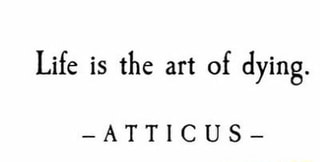
(Holy) Dying Well


Going deeper:

https://en.wikipedia.org/wiki/Holy_Living_and_Holy_Dying

https://www.psychologytoday.com/us/blog/the-lost-art/202003/the-lost-art-dying-well

https://www.sfgate.com/news/article/Pastors-talk-a-lot-about-death-Now-covid-19-is-15192087.php

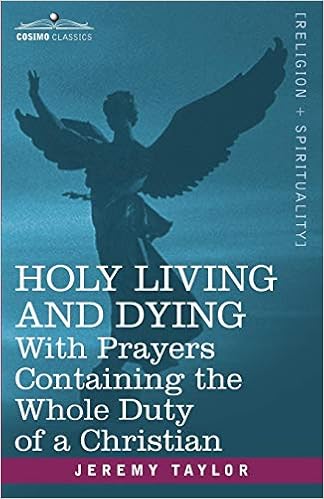
Holy Living & Holy Dying – Part One


"It is a great art to die well, and to be learnt by men in health..."- Jeremy Taylor

I was listening to a podcast by the Yale Center for Faith & Culture on “The Art of Living and Dying During COVID-19 / Lydia Dugdale, MD”

It was a really interesting podcast and it reminded me the idea of dying well goes back to the middle ages when the bubonic plague was at its worst. There were many devotional books on the ars moriendi – the art of dying.

In our heritage as Episcopalians, there was an Anglican Bishop named Jeremy Taylor who in 1650 & 1651 wrote two books – Holy Living & Holy Dying. (They are still in print today.)

His books were devotionals that both lay and clergy could use in the face of death. His books made the point that if we are to have a holy death, then we start when we are healthy, by living a holy life.

In fact, his point goes beyond only prescriptions but thinking of our lives like an artist would. Living and dying are not two distinct temporalities of human life. Rather, they were two different points along the same continuum. Holy Dying is a matter of holy living.

At the end of our lives, the question for us is what kind of masterpiece will we be?

Over the course of the next several Sundays, I want to explore this holy living and the great art of dying well…

Let me leave you thinking about it this way. These quotes come from Rabbi Zusha of Anipoli (lived 100 years after Bishop Taylor) and get us to think about who we are as individuals in God’s creation:

  • "If it were offered to me to exchange places with Abraham, I would refuse. What would God gain from this? He'd still have one Zusha and one Abraham."
  • "When I appear before the heavenly court they will not ask, 'Why weren't you Moses'. They will ask, 'Why weren't you Zusha'."