Sunday, November 24, 2019

November 24 Sermon

Given at the 8 am service...
Eternal God, the refuge and help of all your children, we praise you for all you have given us, for all you have done for us, for all that you are to us. In our weakness, you are strength, in our darkness, you are light, in our sorrow, you are comfort and peace. We cannot number your blessings, we cannot declare your love: For all your blessings we bless you. May we live as in your presence, and love the things that you love, and serve you in our daily lives; through Jesus Christ our Lord and King. Amen. ~ written by St. Boniface (ca. 672-754)

Today is Christ the King Sunday. The last Sunday of our Church Year before we once again contemplate the mystery of Christmas through the Season of Advent. We end the year considering Jesus as our King.

But our Gospel reading from Luke presents us with a paradox: Christ our exalted King dies on a cross as a common criminal. Jesus is not your typical King.

· He refuses worldly power.
· He refuses (angelic) assistance.
· He refuses to be self-serving.

On the cross Jesus said, "Father, forgive them; for they do not know what they are doing."

He doesn’t seek vengeance or revenge for what has happened. He offers forgiveness.

Even as people stood by and watched the crucifixion; some scoffed at him, “let him save himself if he is the Messiah of God." Some mocked him, "If you are the King of the Jews, save yourself!" One of the criminals kept deriding him, "Are you not the Messiah? Save yourself and us!"

I wonder if Jesus felt all alone as he hung on the cross; I wonder if he was tempted to save himself.

But the other criminal rebuked the first criminal, saying, "Do you not fear God, since you are under the same sentence of condemnation? And we indeed have been condemned justly, for we are getting what we deserve for our deeds, but this man has done nothing wrong."

Then he said, "Jesus, remember me when you come into your kingdom."

To which, Jesus replied, "Truly I tell you, today you will be with me in Paradise."

And on the cross, after all he has suffered, at the worst of moments, Jesus gives mercy to another. What king do we follow?

We follow Jesus, whose instinct was always to act out of love. Even when the world came crashing down, he still offered forgiveness and mercy.

Maybe that should be part of our lives too.

Julian Fellowes, the creator of Downton Abbey and writer of the film’s screenplay, explains that the premise for the feature film is based on an actual visit of King George V and Queen Mary to Yorkshire in England in 1912. King George revived the custom of the “traveling monarch,” trips intended to bring the royal family in direct touch with the British people. The last “traveling monarch” was Queen Elizabeth I, who reigned more than 300 years before. At parades, tours of farms and mines, dinners and other public events, the people of England got to see and hear their king and queen. King George wanted his people to feel a sense of “ownership of the crown,” to make the monarchy more than just a concept or impersonal institution but for them to see their monarchs as real flesh-and-blood human beings.

The trip that inspired the Downton Abbey film was overshadowed by an explosion at the nearby Cadeby Main Colliery coal mine that killed 91 people on the second day of the royal couple’s visit. King George and Queen Mary after learning of the disaster, went to comfort the injured at the site. That evening, the queen and king arrived at the mine and — much to the amazement of onlookers — they shook the dirty hands of miners who had been recovering bodies all day and night.

The town was so grateful that they flocked that evening to Wentworth Woodhouse, where the royal couple was staying. A crowd estimated at some 25,000, including 600 miners, waved torches as a choir sang patriotic songs. The crowd came to absolute quiet as King George began to speak. He thanked them for their presence and their wonderful visit to Yorkshire and paid tribute again to those killed at Cadeby and their families. The crowd cheered mightily in response.

That day is said to have changed the protocol for royal visits ever since. [The New York Times, September 22, 2019; Vanity Fair, July 23, 2019.]

For the people of England, the monarchy is not a relic of a distant past or quaint institution of former times: the king and queen represent the ideal of who they seek to be as a people; the royal family (to various degrees of success) embody the wisdom and strength, the compassion and faith their subjects seek to live.

We Americans look to the Declaration of Independence and our Constitution to define us as a nation and people — but to the British, the character of their nation is vested in their monarch. It is that understanding of “kingship” that is at the heart of today’s Christ the King Sunday.

Our baptism into the life of Christ was and continues to be our proclamation to the world: that the Jesus of the Gospel is Lord of our lives, that we share his vision of the world and seek to fulfill the hope of his kingdom. To claim Christ as King means to make his vision of compassion and justice the measure of our integrity and the compass for our journey through this life to the life of the world to come.

May our lives follow his example, that through love, forgiveness and mercy, we may proclaim Jesus as Lord & King to the world. Amen.

Saturday, November 23, 2019

Corners in Time


From St. Gregory's Abbey Letter...

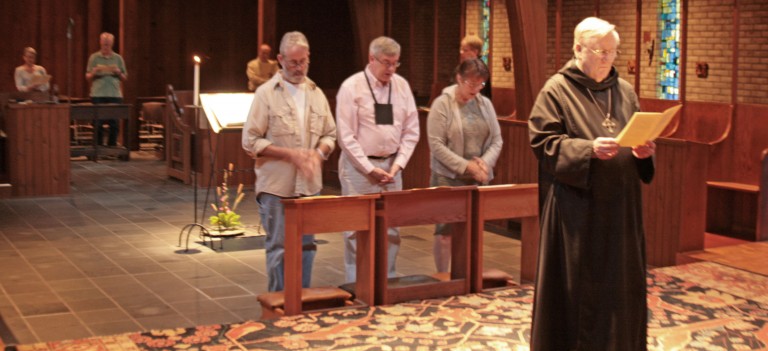
Monastery churches are not exactly public buildings, nor are they private buildings. They are not parish churches (usually), nor are they retreat center chapels. They are places for monastic communities to gather for corporate prayer, but they almost all have spaces for people who are not members of the monastic community to join in the prayer. Even most of the public prayer that goes on in monastery churches is not the usual style of worship that goes on in parish churches, and the furnishings are not what one finds in a normal church building. Our church has an area where guests sit, and it has a space for our celebration of the Eucharist (an altar or holy table, lectern for public scripture reading, and chairs for those presiding and assisting at the Eucharist). In between the guest area and the altar, however, is where the particularly monastic furniture resides. We monks sit in rows facing each other, perpendicular to the guest seating area. That facilitates our monastic corporate prayer of reciting psalms in antiphonal form (one side recites one verse, the other the next verse, than back to the first side for the next verse, etc.)

The monks sit in “choir stalls” (a seat with a desk for holding the psalm books). These choir stalls are very special places in the lives of nuns and monks. At many monasteries, including here at St. Gregory’s, choir stalls are “assigned seating” (as are our spots in the refectory and chapter room). We sit according to our seniority in the community, and we occupy our particular choir stall until a gap is made in the order above us (by the death or departure of someone ahead of us in seniority). That means that we might be in the same choir stall for years or decades. They become a place where prayer can be cultivated by the occupant; they are often used for private prayer as well as the daily round of corporate prayer.

As the years roll on praying for the many requests we receive, in addition to chanting the same psalms at the same time on the same day every week, we are freed from the notion that our prayer should reflect our own whims and desires, allowing us to open up to allow the Holy Spirit to pray through us. We join in the prayer of all those around the world who have prayed before us and all who will pray after we are long gone. We are held together by the Holy Spirit inside all of us and surrounding us. We learn that our prayer is not about us and does not depend on us, so we never have to worry about “getting it right”. This is all amazingly freeing. We are in a communion of saints who hold us in prayer as we hold others in prayer. We do not and cannot understand our relationship with each other in this communion, but we can live in it and depend on it. We can be at all times and all places with all these others to whom we are joined in prayer.

One does not have to be a monk to have one’s own spot to cultivate prayer. It does help to be stable in one’s prayer time and place, but the important thing is the desire to pray and the honest effort to make oneself available to the Holy Spirit. Any effort is met by grace and is initiated by grace. — Br. Abraham 

(You can find it here.)

Find a Pause for Your Soul this Season


From Bishop Prior of the Episcopal Church in Minnesota... 
“Many people report that the greatest obstacle to their own spiritual development comes from their busy schedules.”
The first time I heard this, from RenewalWorks, it gave me pause. RenewalWorks is “a ministry of Forward Movement, [which] offers a process to gain insight into the spiritual health and the potential for spiritual growth in congregations.” Through the years, this organization has provided some interesting insights into the health and vitality of faith communities and the individuals who participate in them.

Busyness is THE greatest obstacle to our own spiritual development.  I invite you to pause and reflect on this. Ask yourself if that statement rings true for you.
  • Pause?
  • Reflect?
  • I don’t have time for that!
I think many of us would say that the busyness of our lives can be challenging on a number of fronts, including to our spiritual development.

Though we often complain about how busy we are, we actually draw a strong sense of purpose and identity from being busy. If we are busy, we must be needed; we must have some importance. Busyness has become powerful in our world. And it has come with a cost to our relationships to one another and to God.

In some respects, the Church has been well aware of this identity of busyness for a long time, and it offers a counter-narrative. Embedded in the cycle of our liturgical year, which begins on December 1st with the first Sunday of Advent, are intentional invitations for us to take a break from our busyness and create space for our souls.

Advent and Lent in particular are times for us to fully embrace those liturgical seasons that encourage pause and reflection. You may be interested to know that RenewalWorks also provides research on what can be helpful for spiritual development. “Research indicates identifiable catalysts that can bring transformation and spiritual growth in the lives of parishioners.” Here are three of them:
  • Engagement with scripture
  • The transforming power of the Eucharist
  • A deeper prayer life
On the cusp of the holiday season, (yes I am aware that for some it started before Halloween!) and with Advent right around the corner, in the midst of a strong cultural narrative of “the busier the better,” I encourage all of us to set aside some time for our souls to pause and reflect.

From here.

Christ the King Poem

Christ The King

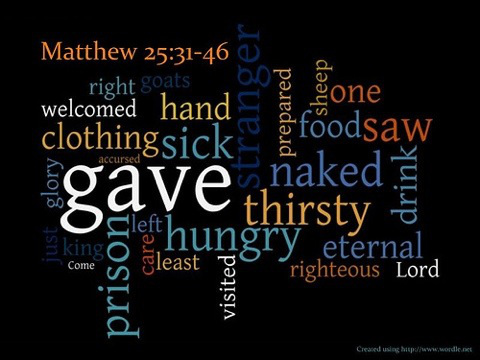
Mathew 25: 31-46

Our King is calling from the hungry furrows
Whilst we are cruising through the aisles of plenty,
Our hoardings screen us from the man of sorrows,
Our soundtracks drown his murmur: ‘I am thirsty’.
He stands in line to sign in as a stranger
And seek a welcome from the world he made,
We see him only as a threat, a danger,
He asks for clothes, we strip-search him instead.
And if he should fall sick then we take care
That he does not infect our private health,
We lock him in the prisons of our fear
Lest he unlock the prison of our wealth.
But still on Sunday we shall stand and sing
The praises of our hidden Lord and King.

(Poem by Malcolm Guite)

Monday, November 18, 2019

Sermon November 17

Holy Spirit, Give us a discerning eye and an enquiring mind that we may better understand the stories by which our lives are shaped; and gracious Lord, give us a brave heart and gentle hands that we may better shape the stories through which our lives will be understood. We pray in Jesus name. Amen.  (Pat Bennett)

I think Jesus was trying to change the story.

Some looked at the temple, how it was adorned with beautiful stones and gifts dedicated to God, and believed in its magnificence. What could ever happen to it?

Jesus said, "As for these things that you see, the days will come when not one stone will be left upon another; all will be thrown down."

Now one could continue on in this passage from the Gospel of Luke and wrestle with the apocalyptic symbolism and the meaning in his message. For there is hope in it even as we are startled by his words. But I want us to think about those precious stones.

It is so easy to get caught up in what we build and what we make of our lives, those precious stones. But if we are honest with ourselves, we know that so much of what we have, can be lost in an instance.

I remember watching the fire that ravaged Norte Dame in Paris. Such a magnificent cathedral, a hopeful and religious symbol for so many people since its beginning in 1163, that if not for the bravery of the Paris Fire Fighters, would have been a total loss. Its gothic architecture, its stones would have been thrown down. Just as the Brazilian museum fire from last year brought an ‘incalculable’ loss to the 200-year-old Rio institution that housed so many artifacts…

The Cathedral has lasted nearly 900 years and remains a place of sanctuary, of worship, of hope, speaks to our deeply held connection with one another, with God and with those beautiful stones.

And yet, if the cathedral did fall, it would be a great loss but our faith would go on. Just as that temple did fall to the Romans and was destroyed in the year 70, the faith of Jews & Christians marched on, even as the world seemed so terribly destructive and persecution arose.

What about our lives. What magnificent things do we have, those precious stones we admire.

I think Jesus wants us to change our story with them too. As one author put it…

“For those early Christians embraced a new story, the story of Jesus opened their eyes to see history not as a narrative of the empire’s achievements but as a narrative of God’s redemptive work in the world, which often occurs in quiet and mysterious ways. For them, Bethlehem and Golgotha occupied center stage, not Rome.

Jesus Christ reshaped identity. He promised to make people new creatures; he broke down dividing walls of hostility; he transformed how his followers saw themselves and treated “the other.” “ (Gerald L. Sittser, Resilient Faith: How the Early Christian “Third Way” Changed the World.)

Our story today does not lie with our precious stones, but with our faith in Jesus, our love for one another, and the hope we have in God’s new creation. Jesus calls us to re-center our priorities on our faith and living out that faith in righteousness, even in the worst of times.

For us to truly believe in this story of Jesus; to live into it, we must face into loss, into death and resurrection.

A physician, an expert in palliative care, was giving a presentation on the process of preparing to die.

He began by asking participants to make three lists: First, they were to write down five possessions that gave them pleasure; second, five activities that gave them joy; and third, the five people they loved most in the world.

After the audience completed their lists, the doctor began talking about a hypothetical patient, a woman whose days were filled with the usual routines, jobs and stresses of everyday life. But after she discovered a lump in her body, there came a cascade of medical interventions: first, a biopsy, then surgery, radiation, and chemotherapy. After a year, it became clear that the treatments weren’t working, and the oncologist told her to get her affairs in order. She entered hospice care, and gradually her world shrank to the size of her bedroom.

And throughout the story, the doctor periodically paused to ask participants to cross an item off their lists.

The possessions and activities went first, of course. Each was a choice: Which would I have to give up more, my laptop or my car? Biking or walking? Then it came time to start crossing off people, each decision an agonizing, Sophie’s Choice dilemma. By now it was clear where this exercise was heading and most participants, even the men, were borrowing tissues from the women who were organized enough to keep a packet in their purses. By the time the physician’s hypothetical patient died, everyone has gone through a similar shedding of what they held dearest, leaving the audience the emotional equivalent of wet noodles. [From “We need to talk about death” by Lori Erickson, The Christian Century, August 28, 2019.]

This stripping away of possessions, status, and relationships happens to everyone as they die — and will one day happen to each one of us. Even though we believe that death is not the ultimate end, we can’t deny that, in the short term, there’s plenty of sadness to go around.

Jesus makes clear in today’s Gospel that our entire lives are a series of “deaths”: of letting go, of changing, of adapting to a new set of circumstances. But we believe that every “death” can result in some form of resurrection: a new understanding, a new insight, a new appreciation.

Today’s Gospel should not terrify us or deflate our sense of hope, but make us aware of the things of the world that will one day be gone and the lasting things of God that are the means of peace and joy as we journey from this world to the next.

In the end, those precious stones will not be ours to hold onto, but the stories through which our lives will be understood, those stories that we have changed in faith will guide us to a deeper relationship with God & with one another whatever may come in this world. Amen.

Articles from Sunday's Sermon

There were a couple of articles that I read and used as part of Sunday Sermon.

Both are very good articles.

(1) We’re all going to die. Why is it so hard to talk about it?

It’s not as if it’s a big secret that we’re all going to die. It’s just that for many of us, most of the time, it seems like an event that’s going to happen to someone else, some hypothetical me far in the future. Spiritual teachers in many traditions spend a lot of time trying to get people to see the foolishness of this perspective.

“To contemplate dying each day calls forth an instant reordering of priorities,” writes Kathleen Dowling Singh in The Grace in Aging: Awaken as You Grow Older. “Just like a quick and deliberate shake of a kaleidoscope, it creates a whole new patterning, a whole new view.” I’ve seen that shake of the kaleidoscope happen many times in those who’ve received a terminal diagnosis...
(2) The Early Church Thrived Amid Secularism and Shows How We Can, Too

The success of the early church was certainly not inevitable. Christians could have accommodated to the culture to win recognition and approval, which would have undermined the uniqueness of their belief system and way of life. Or Christians could have isolated themselves from the culture to hide and survive, which would have kept them on the margins—safe, to be sure, but also irrelevant.

Instead, Christians engaged the culture without excessive compromise and remained separate from the culture without excessive isolation. Christians figured out how to be both faithful and winsome. They followed what was then known as the “Third Way,” a phrase that first appeared in a second-century letter to a Roman official named Diognetus.

What made the Third Way so successful and fruitful? At the heart of it was the unique identity and mission of Jesus. Jesus Christ shaped everything that followed in his wake. No one in the ancient world had ever encountered the likes of him before. Romans had no categories for him and neither did Jews. Not even his disciples could make sense of him until after the resurrection. Jesus Christ summoned his followers to a new way of life because he was first and foremost the way to new life. In other words, it was his uniqueness that made the early Christian movement unique.
I encourage you to read them both.

Prayer with Forward Movement (online)


"The Forward Movement Prayer Site gives you some vital tools to have a habit of daily prayer.” —The Rev. Canon Scott Gunn
Forward Movement debuted the Prayer Site in 2012 to create an online community of disciples who wished to discuss the daily meditations from Forward Day by Day.

Today, thousands of people access the site each day to pray, learn, and worship individually or corporally. As we follow Jesus along the Way of Love, we pray that you will visit our Prayer Site and add it to your toolbox of spiritual resources.

How can you interact with our Daily Prayer site?
https://prayer.forwardmovement.org/