Monday, December 17, 2018

Creation Care & Climate Change


Jones Family Farm (Shelton)
Care and justice for all creation is a core value of The Episcopal Church. 

Creation care ministries seek to heal, defend, and work toward justice for all God's creation and to respect the kinship and connection of all that God created through education, advocacy, and action. In order to create capacity in the church for environmental stewardship initiatives, and in response to Resolution A030 of the 78th General Convention, the Advisory Council for the Stewardship of Creation was appointed in 2016.

The Presiding Bishop's Delegation to the UN Climate Change Conference (known as the COP): This is an annual intergovernmental meeting to focus on global dialogue and action around the United Nations Framework Convention on Climate Change. Follow along with us on social media using #EpiscopalClimate   

Learn about the Episcopal Church and Climate Change including the goals for COP24 here.

The Spirit of Apollo


Join the National Air and Space Museum in commemorating the 50th anniversary of Apollo 8 with an evening at Washington National Cathedral.

Apollo 8 was the first human mission to the Moon, and its crew were the first people to see the far side with their own eyes. The mission’s dramatic highlights included a live Christmas Eve broadcast during which the astronauts read verses from the Book of Genesis in lunar orbit, and the iconic Earthrise photo, which stunned the world with the beauty and isolation of our home in the cosmos.

The evening’s speakers, including Apollo 8 astronaut Jim Lovell and Presiding Bishop of the Episcopal Church Michael Curry, will celebrate that moment of unity and the spiritual meaning of exploration embodied by the first flight to the Moon. A dramatic choral performance will recreate the famous Christmas Eve Broadcast. Apollo 8 challenged our understanding of human limitations. Fifty years later, we come together to honor the Spirit of Apollo.


You can find the program and the webcast by going here and here.

Universal Declaration of Human Rights


Human rights through an Anglican lens

excerpt:
 
Today (10 December), we commemorate the 70th anniversary of the Universal Declaration of Human Rights, adopted in 1948 by the newly-established United Nations organisation in the aftermath of the Second World War. Some Christians sit uncomfortably with the growth of the modern human rights movement, seeing it as a “secular religion” which threatens to displace our faith, especially as Christian belief and practice declines in the countries of the Global North.

Speaking as one from the Global South, I have no such discomfort – especially coming from a country in which our faith was perverted by Christian churches to propagate the notion that separating people on the basis of race and ethnicity is necessary to peaceful human co-existence, thus denying our conviction that “There is no longer Jew or Greek, there is no longer slave or free, there is no longer male and female; for all of you are one in Christ Jesus” (Galations 3:28).

Let’s look at human rights through an Anglican lens, using Scripture, Tradition, Reason and Experience to interpret our context. Taking those touchstones seriously, using reason to consider our experience in the light of scripture, it seems to me that when we seek guidance from our faith on how to we should live in the world, we can begin with God’s words in Genesis: “Let us make humankind in our image” (1:26).

For if each one of us is made in God’s image, then as Desmond Tutu has said, we are God-carriers, and to treat any one of God’s children as less than this is not simply unjust, it is not simply painful for the one so treated, it is “blasphemous – like spitting in the face of God.”

Read the Archbishop of Cape Town and Primate of the Anglican Church of Southern Africa, Thabo Makgoba's powerful words here. 

A prayer:

O HOLY GOD, you love righteousness and hate iniquity: Strengthen, we pray, the hands of all who strive for justice throughout the world, and, seeing that all human beings are your offspring, move us to share the pain of those who are oppressed, and to promote the dignity and freedom of every person; through Jesus Christ the Liberator, who lives and reigns with you and the Holy Spirit, one God, for ever and ever. Amen.

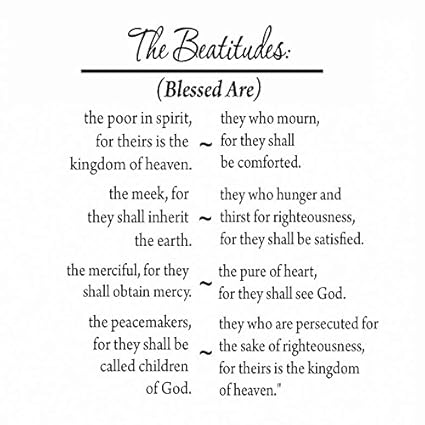
Thinking about the Beatitudes

A wonderful set of essays can be found here:

http://ismreview.yale.edu/issue/volume-4-2-beatitudes/

I have previously blogged on this:

https://stpetesrock.blogspot.com/2017/11/the-beatitudes-for-discipleship.html

https://stpetesrock.blogspot.com/2017/01/the-ladder-of-beatitudes.html

https://stpetesrock.blogspot.com/2017/01/livingbeatitudes.html


Sunday, December 16, 2018

Sermon Advent 3 (Dec 16)

O God, by whom the meek are guided in judgment, and light riseth up in darkness for the godly: Grant us, in all our doubts and uncertainties, the grace to ask what thou wouldest have us to do, that the Spirit of wisdom may save us from all false choices, and that in thy light we may see light, and in thy straight path may not stumble; through Jesus Christ our Lord. Amen.

I will remove disaster from you, so that you will not bear reproach for it.
I will deal with all your oppressors at that time.
And I will save the lame and gather the outcast,
and I will change their shame into praise and renown in all the earth.
At that time I will bring you home, at the time when I gather you;

These beautiful lines from Zephaniah, one of the minor prophets of the OT, talks about the restoration of Israel after they had been attacked and dispersed by other peoples over the centuries. God would bring his people home. God would save them.

Such a depiction of God would have been missing from the Slave Bible.

A new exhibit at a Washington, D.C., museum features an abridged version of the KJV Bible. It sheds light on how Christian missionaries converted enslaved Africans to Christianity by teaching them the Gospel... except the parts about freedom, equality and resistance.

According to NPR, Parts of the Holy Bible, Selected For the Use of the Negro Slaves, in the British West-India Islands, is on display at the Museum of the Bible in Washington, D.C., and is one of only three known copies of this abridged version. Printed in 1807, the text of the Bible was used by missionaries from England to convert slaves to Christianity. The censored version removed 90 percent of the Old Testament and 50 percent of the New Testament. (from the Root)

Verses that reinforced the institution of slavery were kept. "Servants, be obedient to them that are your masters according to the flesh, with fear and trembling, in singleness of your heart, as unto Christ." (Ephesians 6:5)

Others including Thomas Jefferson have remade the Bible to fit their beliefs. The problem with such selection, is we make the Bible into our image, forcing it to be something it was not intended to be. For such censoring, I believe makes us miss what are important lessons for us today.

You brood of vipers! Who warned you to flee from the wrath to come?

John the Baptist’s harsh rhetoric still challenges us today. No one likes to be called a brood of vipers and I wonder how many people would cut his words out from tehri bible (I wonder if it was in the slave bible.). John is not just insulting us, he is trying to get our attention.

Bear fruits worthy of repentance.

The fruit he is talking about is our lives. What fruit do we bear in our lives?

One pastor remembers the fruits of his Grandma:

As far as I know, Grandpa never discovered the secret my grandmother and I shared. Every Saturday she and I whisked into town in her faded blue Ford Torino. As I pushed our cart up and down the aisles of the Red & White, she carefully selected food in duplicate—two boxes of cereal, two jars of peanut butter, two bags of flour—until our cart looked like an abstract rendering of Noah’s ark with its produce and nonperishable food items arranged two by two.

Then we’d check out (an achingly slow process involving a hefty stack of coupons), load the car with heavy paper grocery bags, and drive straight to the town’s food bank, where my grandmother would donate exactly half of everything she’d just purchased. She bought my silence each week with a small candy bar, which was not immune to her rule: one chocolate treat for me, one for the food bank.

I never asked my grandmother whether our weekly grocery run was a direct response to Luke 3. “Whoever has two coats must share with anyone who has none,” and “whoever has food must do likewise.”

“What shall we do?” ask the crowds, tax collectors, and soldiers in this passage. We are more inclined to ask, “Isn’t it perfectly rational, even necessary, to hang on to a fleece pullover for the fall, a down coat for winter, and a lightweight rain jacket for spring?” By situating ourselves in a radically different place and time from John, we think we can wiggle our way out of his demands for ethical living.

The question at the heart of this text—“What shall we do?”—differs significantly from “What shall we believe?” or even “What shall we prayerfully discern as our role in mission?” It differs more still from the question that, if we are honest, we know we have asked: “How shall we interpret John’s words in such a way that we may maintain our comfort while our neighbors suffer?” John’s response is clear. Repentance has to do with ethics, with action, with the Holy Spirit’s compelling us to be God’s hands and feet in the world—with attention to the needs of others rather than preoccupation with our own salvation.

By the world’s measure, my understanding of John’s preaching is more nuanced than my grandmother’s. But no advanced degree in theology will ever come close to her faith. “What shall we do?” the people ask the prophet. Sometimes we like to pretend the answer is complicated. Sometimes it really is. But buying two bags of flour and giving one away is a good start. (Christian Century)

The pastor’s grandmother grasped the Gospel in a simple and yet direct way. She bore that fruit that John talked about. "What then should we do?"

Share.

I think of an economics professor who was traveling through a village in his native country. Famine had devastated the region. He met a woman who struggled to provide for her family by weaving bamboo stools. Her work was excellent, but no bank would ever lend her money to buy materials. The professor gave the woman and several of her struggling neighbors $27 from his own pocket as a "loan." He never thought any more about it — until the borrowers repaid the money in full, and on time.

So the professor began making other loans to groups of villagers. Some used the money — often as little as $20 — to buy another cow or a sewing machine or to expand their rice patties or mustard fields. Most of the borrowers were women.

In 1976, he formalized his loan-making arrangement as the Grameen Bank in Bangladesh. Grameen operates on the principle of trust rather than financial capacity: that the poor can be as creditworthy as the rich.

Since its founding, Grameen Bank has lent out around $6 billion to some 6.6 million borrowers who have paid back 98.5% of their loans.

In 2006, the professor who lent $27 to a poor weaver some 30 years ago prior was awarded the Nobel Peace Prize to Dr. Mohammed Yunas and Grameen Bank.

Doctor Yunas' ultimate goal: that "one day our grandchil­dren will have go to museums to see what poverty was like."

“Whoever has two coats must share with anyone who has none; and whoever has food must do likewise.” We are called to do likewise. It is to care for our neighbor by living a simple, ethical and moral life.

No matter how we cut it, the ethical calling is clear. To follow Jesus, is to hear the demands of John, for he is not interested in our hesitation. He wants action.

Be it from the crowds, the traitorous tax collectors, or the Roman soldiers.

And from you and me.

Bear fruits worthy of repentance.

Share.

Be humble and kind.

Live and rejoice.

Amen.

Thursday, December 13, 2018

December 14...

We remember...


Darkness cannot drive out darkness; only light can do that. Hate cannot drive out hate; only love can do that. ~ Martin Luther King, Jr.

Hope is being able to see that there is light despite all of the darkness. ~ Desmond Tutu 

 
O gracious and loving God, on this anniversary of the tragedy in Sandy Hook, we remember all the victims who lost their lives to hate. We remember the brave and courageous who rushed to the scene to help and those who have given comfort in the months and years afterward. We remember those who continue to grieve loved ones lost, for the survivors and for all the anxiety and fear we had in those days. We also remember how we came together to support one another in a time of need. Have mercy, Lord, give us strength and peace to practice kindness in the midst of hate; make us courageous in compassion and in justice for all. Help us to know your steadfast love & hope, your presence that is as near as breath; rekindle in our hearts the hope of life that conquers death. This we ask in your son’s name, Jesus our Lord. Amen.

Sunday, December 9, 2018

Advent on the Green Sermon Notes

Given at Chapel on the Green in New Haven on Dec. 9 @ 2 pm.

John the Baptist (repentance & Preparation) & St. Nicholas (wonder worker & gift giver)

“so devoted to serving God that the Spirit coursed through their lives unchecked, touching with grace all those they encountered”

Someone you may not have noticed is waiting,
longing for healing, for justice, for hope.
You only mean to be passing by,
but they see you.
And even if they don't know they are asking,
they are asking.

“Are you the one?”

Not necessarily the Messiah, but perhaps like the messengers of old
one to bring hope,
to be a light in the darkness.
There may be someone in some kind of prison
looking for some kind of encouragement,
someone longing for healing or appreciation or forgiveness.
Will you be the one, or should they wait for another?
There may be people of color who see a white person
and assume racism, until they see otherwise.
There may be a non-conforming person
who assumes you will judge them
unless you clearly don't.
Will you be the one to shine light in their darkness,
or are they to wait for another?

Sit still in the grace of God.
Let the light that is dawning for the world
dawn in you.
Let that light grow and radiate.
Bear it with you through the day.
You will meet someone who seeks grace,
who longs for a sign of hope.
And for them
you will be the one.
(Steve Garnaas-Holmes)

Today, this Advent, for those looking, may you and I be the one. Amen.