Sunday, July 12, 2020

Proper 10 Sermon

Creator God, unceasingly at work in the field of humanity sowing the good seed and awaiting its yield, let your Spirit move in power over us to transform our hearts into the good soil you seek. Then may your word bear fruit a hundredfold in our deeds of justice and peace, and thus reveal to a world that eagerly awaits its liberation the blessed hope and glorious freedom of your holy reign. We ask this through our Lord Jesus Christ, your Son, who lives and reigns with you in the unity of the Holy Spirit, one God for ever and ever. Amen. (Peter J. Scagnelli)

We plow the fields and scatter the good seed on the land,
it is fed and watered by God’s almighty hand…

Whenever we hear the Parable of the Sower, I think of that beautiful hymn, reminding us that even as we scatter seed, God plays God’s part, as we do ours.

Whenever we get to these parables of Jesus, we need to remember that a parable is not like an Aesop Fable with a moral at the end, it is not like the stories we so often hear. Parables are metaphors rooted in images of everyday life and yet as the parable unfolds the metaphors are shattered, things are not as they seem, and they challenge our vision of reality.

Parables are open ended, with multiple meanings and layers to those stories, they are not so simple. That is why the disciples often asked Jesus to explain his parables. If Jesus had wanted to, he could have given a simple story or command like “love one another” as he did elsewhere. But to the crowd and his disciple he often spoke in parable.
A parable is “where the ordinary has gone askew and thereby shocks us into realizing that the parable leads us into another way of thinking about life.” (John R. Donahue)
Today we have the Parable of the Sower – of one who scatters seeds everywhere…

"This is not about what good soil we are, and how well we understand the divine mysteries. This is about what God is doing in staggering numbers." (Anna Carter Florence)

So let’s think about this parable of the Kingdom as the sower sowing seeds everywhere, seeing where it indeed will take root through a story of today…

In 2007, Ozlem Cekic was the first Muslim immigrant woman elected to the Danish Parliament. Ozlem’s family came to Denmark in the 1980s when she was a child.

Soon after the election, the new legislator was inundated with hate mail — vile and racist, threatening her and her family. At first, she just deleted the e-mails, dismissing them as the work of fanatics. But one day a friend made an unexpected suggestion: reach out to the hate mail writers and invite them to meet for coffee. So Ozlem decided to call a man named Ingolf who had sent several nasty e-mails to her. Ozlem asked if she could come to his home for coffee; she would bring food.

In an interview on NPR, Ozlem remembers: “I was so nervous about what he would say. And the first thing he said was, ‘I have to ask my wife.’ And I think, wow, so he’s like my father — he always wants to ask my mom before he decides something, you know? So it was the first time that Ingolf [seemed] normal for me.”

After nervous introductions, the two began to talk, starting with their childhoods. From those stories, they moved on to talking about the things they disagreed about — and, to their surprise, things they agreed on.

Because Ozlem was willing to make the call, Ingolf became a real person to her — and she to him. It was the first of many conversations over coffee she would have in her eight years in Parliament with critics and detractors — and she continues her #DialogueCoffee initiative now that she is out of office.

“The vast majority of people I approach agree to meet me . . . Along the way, I have learned some valuable lessons. The people who sent hate mails are workers, husbands, wives, parents — like you and me. I’m not saying that their behavior is acceptable. But I have learned to distance myself from the hateful views without distancing myself from the person who’s expressing those views.

“During these meetings, specific themes keeps coming up. They all seem to think that other people are to blame for the hate and for the generalization of groups. They all believe that other people have to stop demonizing. They point at politicians, the media, their neighbor or the bus driver who stops ten meters away. But then I ask, What about you? What can you do? The reply is usually, I have no influence, I have no power.

“I know that feeling. For a large part of my life, I also thought that I don’t have any power and influence. But today, I know the reality is different. We all have power and influence where we are. So we must never underestimate our own potential. Trenches have been dug between people, yes. But we all have the ability to build the bridges that cross the trenches.” [TED Radio Hour, NPR, January 19, 2019.]

Ozlem Cekic’s #DialogueCoffee initiative is a contemporary image of Jesus’ parable of the sower: to possess the faith to sow seeds of compassion, understanding and justice on whatever “ground” we can. An encouraging word, a kind act, a moment to listen can all result in a harvest of hope we cannot imagine.

Jesus challenges us in the parable of the sower to be both sower and seed: If we seek peace, have we planted the seeds to realize such peace? If we seek trust and understanding, have we cultivated the ground to nurture such trust? If we seek a loving and giving family life, have we created the climate of acceptance and forgiveness that makes such love and understanding possible?

Christ calls us, as his disciples, to be sowers of the things and values of God in order to one day reap the harvest of God’s reign. For God is not done yet. planting seeds all over the place.

As Bishop Andy Doyle reminds us “We are to be, like Jesus, sowers of the seeds of the kingdom of God. We are to sow with abandonment. We are to sow in all kinds of places. We are to not worry about what grows but it is the production of fruit and the spread of the Good News that is our essential work.” Amen.

Wednesday, July 8, 2020

Speaking of Freedom - A Letter to the Episcopal Church

 
A Letter to the Church from the Rev's Winnie Varghese, Kelly Brown Douglas, and Stephanie Spellers (July 4, 2020):

On this day, July 4th, our country celebrates its Independence. Our Episcopal Church also marks this as a major Feast Day, a day to pray in thanksgiving for the founders who “won liberty for themselves and for us, and lit the torch of freedom for nations then unborn.”

Yet, we must ask what is the meaning of freedom in such a time as this, when the COVID-19 pandemic disproportionately ravages Black, Brown, and First Nations communities suffering the pre-existing conditions of injustice and inequality? What is the meaning of freedom, when Black bodies continue to be brutalized by policing that has its roots in slave patrols? What is freedom when our Breonnas are not safe in their homes, our Ahmauds are not safe jogging, and our Erics, Elijahs, and Georges cry out, “I can’t breathe”?

For the church, freedom must be more than a song we sing or a flag we wave. It must begin with the cross that calls us to claim freedom – and to free our church and nation – from America’s original sin: White supremacy. We long for the day that our church might be free to become what we have until now only aspired to be: a true church following a crucified and risen Lord and witnessing to God’s just future.

And so we write this day, three women, three Episcopal priests, two of African descent, one South Indian, reflecting on what freedom means. We are fueled by a shared hope that our Episcopal Church can indeed live into what it means to be church and thus lead the nation into what it means to be truly free.
 
Read the whole letter here:


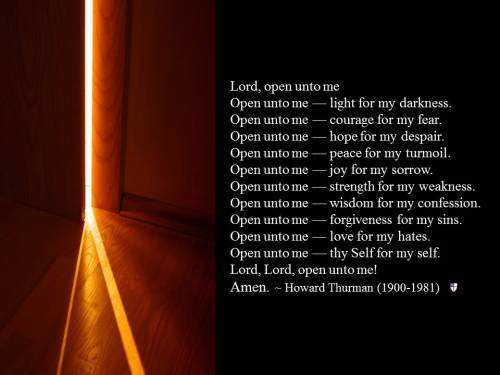
A Prayer of Howard Thurman

Lord, Lord, Open Unto Me

Open unto me, light for my darkness
Open unto me, courage for my fear
Open unto me, hope for my despair
Open unto me, peace for my turmoil
Open unto me, joy for my sorrow
Open unto me, strength for my weakness
Open unto me, wisdom for my confusion
Open unto me, forgiveness for my sins
Open unto me, tenderness for my toughness
Open unto me, love for my hates
Open unto me, Thy Self for myself
Lord, Lord, open unto me!

- Howard Thurman, from "Meditations of the Heart"

Howard Thurman who was born in 1899 and raised in the segregated South. He is recognized as one of the great spiritual leaders of the 20th century renowned for his reflections on humanity and our relationship with God. Thurman was a prolific author (writing at least 20 books); perhaps the most famous is Jesus and the Disinherited (1949), which deeply influenced Martin Luther King, Jr. and other leaders of the Civil Rights Movement. Thurman was the first black person
to be a tenured Dean at a PWI (Boston U). He also co-founded the first interracially pastored, intercultural church in the US.
This prayer was used in our Wednesday meditations.

Habit of Grace (Meditation for Wednesday)


(From our Presiding Bishop, Michael Curry):

The 4th of July weekend has just concluded and a new week has begun, but the titanic struggles of the old world continue. The struggles to face painful truths of our racial past, the struggles to find ways to fashion a new future, the struggles for racial justice and human equality and true human reconciliation. Even in the midst of these struggles, we still face a pandemic that is worldwide. Now the United States itself is gravely threatened and affected by COVID-19. And even in the midst of all of that, we enter a season of electioneering, campaigning, a presidential election that could well be a profoundly polarizing and divisive election for our country.

In this time, I remember the words of Howard Thurman, who I often go back to. Dr. Thurman was one of the founders of probably the first interracial and interreligious church in the United States in San Francisco, back in the forties and fifties. He was the author of Jesus and the Disinherited. He was one of the people who went and met Mahatma Gandhi in the 1940s, and brought back his teachings of non-violent social change that influenced an entire civil rights movement. He was quietly, if you will, the spiritual director of many of the leaders of the civil rights movement. Whitney Young, Roy Wilkins, Martin King, many others went quietly to Howard Thurman to talk, to reflect, to pray. He wrote this in one of his meditations about times of great transition and turmoil:

Look well to the growing edge. All around us, worlds are dying and new worlds are being born. All around us, life is dying and life is being born. The fruit ripens on the tree, the roots are silently at work in the darkness of the earth against a time when there shall be new leaves, fresh blossoms, green fruit. Such as the growing edge. It is the extra breath from the exhausted lung, the one more thing to try when all else has failed. The upward reach of life when weariness closes in upon all endeavor. This is the basis of hope in moments of despair, the incentive to carry on when times are out of joint and men have lost their reason. A source of confidence when worlds crash and dreams whiten into ash. The birth of a child — life's most dramatic answer to death — this is the growing edge incarnate. Look well to the growing edge!

God love you. God bless you. And may God hold us all in those almighty hands of love.

Saturday, July 4, 2020

Going Deeper in the Sermon for Proper 9

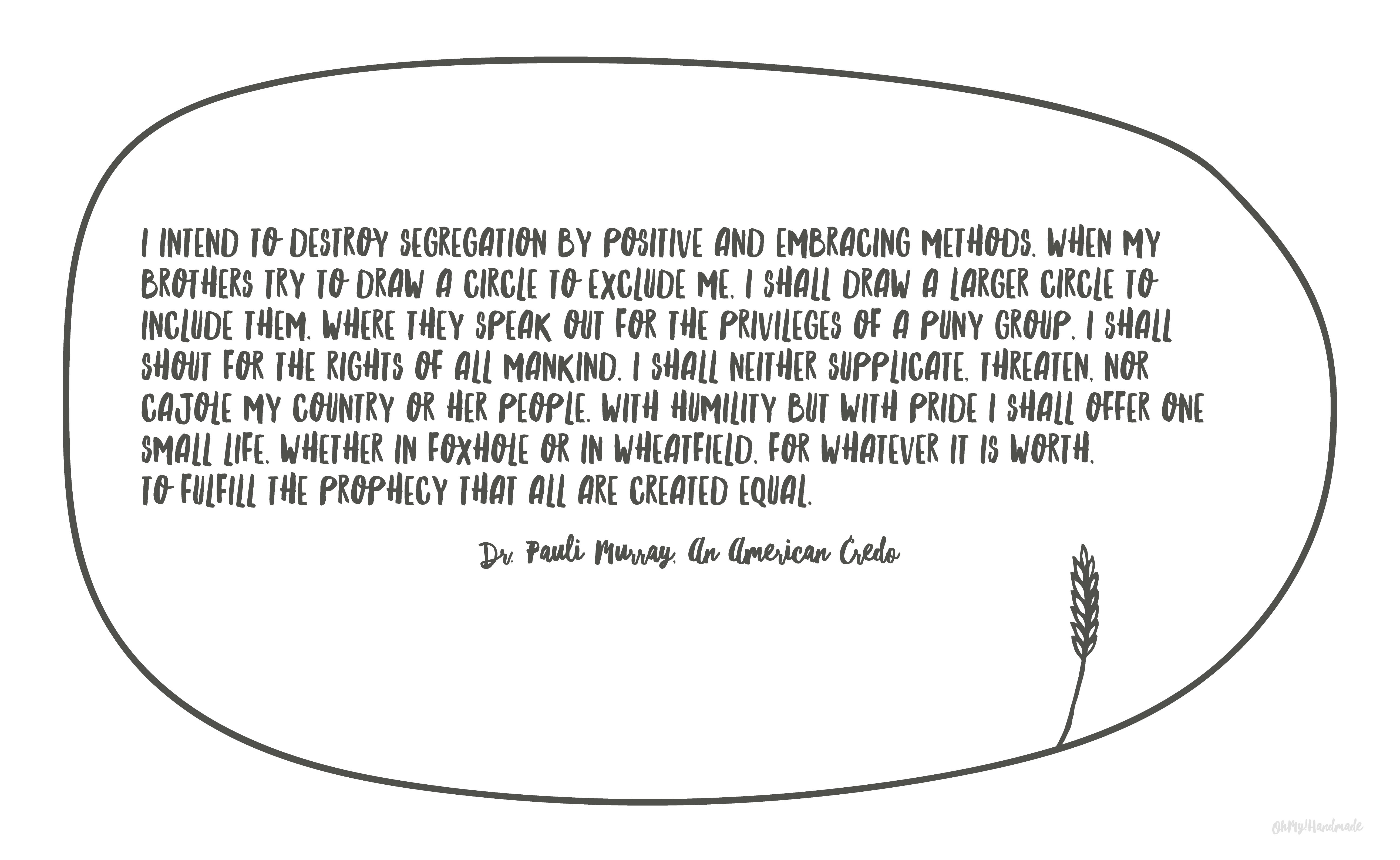
To dive deeper with Paul Murray:

https://ohmyhandmade.com/2016/omhg/featured/draw-a-larger-circle/

https://www.unz.com/print/CommonGround-1945q4-00022

To lean into Pádraig Ó Tuama on the Gospel:

https://www.spiritualityofconflict.com/pdfs/readings/259_fifth-sunday-after-pentecost.pdf

An American Triduum - 2nd of 3 American Feasts

I love the idea of three days of prayer centered around 3 American Feast Days (this is often called a triduum). I think about the three Feast Days of America that are centered on summer & our lives as Americans: Memorial Day, Independence Day and Labor Day. (Next year: I will incorporate some other days we need to include like Pride, Juneteenth, and Indigenous Day) These are appropriate prayers for each of these occasions (from our BCP). It all begins with Memorial Day, and continues today with Independence Day:

Memorial Day

Almighty God, our heavenly Father, in whose hands are the living and the dead; We give you thanks for all your servants who have laid down their lives in the service of our country. Grant to them your mercy and the light of your presence, that the good work which you have begun in them may be perfected; through Jesus Christ your Son our Lord. Amen.

Independence Day

Lord God Almighty, you have made all the peoples of the  earth for your glory, to serve you in freedom and in peace: Give to the people of our country a zeal for justice and the strength of forbearance, that we may use our liberty in accordance with your gracious will; through Jesus Christ our Lord, who lives and reigns with you and the Holy Spirit, one God, for ever and ever. Amen.

Labor Day

Almighty God, you have so linked our lives one with another that all we do affects, for good or ill, all other lives: So guide us in the work we do, that we may do it not for self alone, but for the common good; and, as we seek a proper return for our own labor, make us mindful of the rightful aspirations of other workers, and arouse our concern for those who are out of work; through Jesus Christ our Lord, who lives and reigns with you and the Holy Spirit, one God, for ever and ever.  Amen.

Wednesday, July 1, 2020

Wednesday Meditation


Pauli Murray (November 20, 1910 – July 1, 1985) was an American civil rights activists who became a lawyer, a women's rights activist, Episcopal priest, and author. Drawn to the ministry, in 1977 Murray was the first African-American woman to be ordained as an Episcopal priest, in the first year that any women were ordained by that church. (Wikipedia)

Pauli Murray: Dark Testament Verse 8  

Hope is a crushed stalk 
Between clenched fingers 
Hope is a bird’s wing 
Broken by a stone. 
Hope is a word in a tuneless ditty —
 A word whispered with the wind, 
A dream of forty acres and a mule, 
A cabin of one’s own and a moment to rest, 
A name and place for one’s children 
And children’s children at last . . . 
Hope is a song in a weary throat. 
Give me a song of hope 
And a world where I can sing it. 
Give me a song of faith 
And a people to believe in it. 
Give me a song of kindliness 
And a country where I can live it. 
Give me a song of hope and love 
And a brown girl’s heart to hear it. 

Liberating God, we thank you for the steadfast courage of your servant Pauli Murray, who fought long and well: Unshackle us from the chains of prejudice and fear, that we may show forth the reconciling love and true freedom which you revealed in your Son our Savior Jesus Christ; who lives and reigns with you and the Holy Spirit, one God, now and for ever. Amen. 

Learn more here: