Tuesday, May 12, 2020

Holy Living & Holy Dying – Part One


"It is a great art to die well, and to be learnt by men in health..."- Jeremy Taylor

I was listening to a podcast by the Yale Center for Faith & Culture on “The Art of Living and Dying During COVID-19 / Lydia Dugdale, MD”

It was a really interesting podcast and it reminded me the idea of dying well goes back to the middle ages when the bubonic plague was at its worst. There were many devotional books on the ars moriendi – the art of dying.

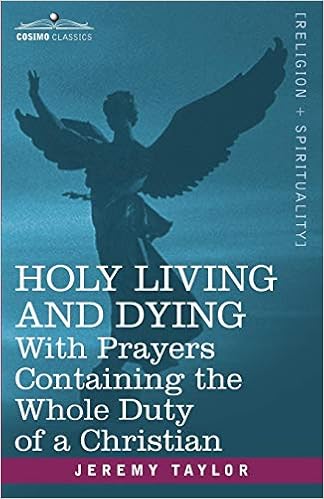
In our heritage as Episcopalians, there was an Anglican Bishop named Jeremy Taylor who in 1650 & 1651 wrote two books – Holy Living & Holy Dying. (They are still in print today.)

His books were devotionals that both lay and clergy could use in the face of death. His books made the point that if we are to have a holy death, then we start when we are healthy, by living a holy life.

In fact, his point goes beyond only prescriptions but thinking of our lives like an artist would. Living and dying are not two distinct temporalities of human life. Rather, they were two different points along the same continuum. Holy Dying is a matter of holy living.

At the end of our lives, the question for us is what kind of masterpiece will we be?

Over the course of the next several Sundays, I want to explore this holy living and the great art of dying well…

Let me leave you thinking about it this way. These quotes come from Rabbi Zusha of Anipoli (lived 100 years after Bishop Taylor) and get us to think about who we are as individuals in God’s creation:

  • "If it were offered to me to exchange places with Abraham, I would refuse. What would God gain from this? He'd still have one Zusha and one Abraham."
  • "When I appear before the heavenly court they will not ask, 'Why weren't you Moses'. They will ask, 'Why weren't you Zusha'."

Saturday, May 9, 2020

Julian of Norwich’s Story of Hope in a Time of Sadness

from growchristians.org (article by )


The feast of Saint Julian (Friday, Oct. 8) finds me during a time when I need her. We get to know her mostly through her book The Revelations of Divine Love, which tells of the visions she received from God when she was on what she thought was her death bed. Right now, I encounter a world that is full of hardship. Even if we are sheltered with our families, our friends or our pets, we seem to still know that the world is anxious, the world is hurting. She offers me amazing hope as a person who sat on a deathbed that was not only not the place of her death, but instead the place where she received visions from God. Her death was not death, but a renewed friendship with God. When she prayed to God from that anxious place, that hurting place, God not only heard her—God replied.

Julian’s deepest wisdom comes from seeing Christ before her, bleeding. She believed that this vision signified God’s proximity to her in her suffering. In these times, Julian reminds us that God is also close to us. When we are sad or struggling, we can remember that we worship a God who has been sad and has struggled. We worship a God who sits beside us when we think we will face the worst and hardest trials, because Jesus has faced the worst and hardest trials, not only for himself, but also for us.

Julian’s message is a message of hope and trust, but it is not a shallow hope or a shallow trust. Her hope and trust come out of a time when she might have felt like that was literally all she had. In a time of uncertainty and scarcity, we might be buoyed by this hope and trust, remembering thanks to her visions that no matter what, we always have the chance to hope and trust in Christ, who knows our worst and hardest trials.

I love that we are celebrating Saint Julian in this specific time of the greater span of life, because I need a vision of the loving, caring God in whom I can put my hope and trust. I need a vision of the God who, when I cry out in my hardest trials, not only hears me, but replies. Saint Julian serves as an image of what it means to receive the vision of a loving God and share it, so we can point to her in this uncertain time, knowing that her life gives us a reminder of hope. Christians are “little Christs,” and we always try to point to Jesus, so I don’t say this to say that we should point to Julian instead of Jesus. I mean this to say that Julian can teach us how to point during a time when even pointing requires an energy we can’t gather. She is someone like us: someone lying in weakness, asking us to wonder how we could be people who point to God in our weakness.

We know so little about Julian, but oddly we know that she was a spiritual counselor for others; people came to her for guidance. I am inspired by her life of not only being honest with God and speaking to God out of her great pain, but then also being a Christian who received the stories of others who were hurting. She loved the hurting when they needed to be loved, pointing to God when saddened people had forgotten how to point to Jesus themselves.

Right now, Julian sits beside the beds we can’t access, bringing with her a story of hope in a time of sadness, a story of visions in a time when she couldn’t imagine the next day, a story of God as her friend and companion when she might have doubted that she had anyone sitting beside her at all.

Tuesday, May 5, 2020

#standwithmashpee - Statement by the Episcopal Bishops of New England

The bishops of the seven Episcopal dioceses of New England have issued the following joint statement urging advocacy for the Mashpee Wampanoag Tribe as it faces the threat of its reservation lands being taken out of trust and disestablishment by the federal government. 

Statement from the Episcopal Bishops of New England on the Disestablishment of the Mashpee Wampanoag Tribe
Easter 2020

The Mashpee Wampanoag Tribe, the People of the First Light, have lived in what is now known as southeastern New England for 12,000 years. Four hundred years ago they sheltered pilgrims in need of refuge and care. After giving that precious gift of hospitality, the Mashpee Wampanoag endured and overcame generations of persecution, oppression and marginalization. Today they are threatened with having their reservation lands taken out of trust and being disestablished by the United States government in their own homeland.

As Christians, we are called by Christ to love our neighbors as ourselves and to grow as a community rooted in love. As Episcopalians, we are called by the Presiding Bishop of the Episcopal Church, the Most Rev. Michael Curry, to work towards a beloved community of racial healing, reconciliation and justice. In this season of Easter in which we celebrate Christ’s Resurrection, we celebrate the Creator’s power of resurrection, justice and love over the powers of death, oppression and empire. In that spirit, we cannot and must not ignore what is happening to the Mashpee Wampanoag Tribe today.

On March 27, 2020, Chairman Cedric Cromwell/Qaqeemasq wrote: “At 4:00 pm today -- on the very day that the United States has reached a record 100,000 confirmed cases of the coronavirus and our Tribe is desperately struggling with responding to this devastating pandemic -- the Bureau of Indian Affairs informed me that the Secretary of the Interior has ordered that our reservation be disestablished and that our land be taken out of trust. Not since the termination era of the mid-twentieth century has a Secretary taken action to disestablish a reservation… It begs the question, what is driving our federal trustee's crusade against our reservation?”

Vice Chairwoman Jesse Little Doe Baird spoke in a statement on March 29, 2020, about the injustice of removing land out of trust for the tribe and putting tribal housing, language and school programs in dire risk. She called for the public to reach out and support the Mashpee Wampanoag Tribe by contacting the Senate and the Secretary of the Interior.

The Episcopal Church renounced the Doctrine of Discovery and expressed solidarity with indigenous peoples. At the same time, we acknowledge that we have made our own mistakes in the past, rooted in colonization, selfishness and prejudice in mistreating the Wampanoag people and the many indigenous peoples of this land. In the Gospels (Mark 2:17), Jesus Christ called his followers to metanoia-that is to repentance-to a change in direction and in our way of life which is lived towards God. In this way we must be connected with and supportive of the Wampanoag and the indigenous peoples of this land. In solidarity with the Mashpee Wampanoag people, we call on the United States Department of the Interior and the political leaders of this land to honor and respect the reservation lands of the Mashpee Wampanoag Tribe.

Responding to the Mashpee Wampanoag call for support and advocating with the tribe, we ask you to consider taking any or all of the actions listed below.

Signed by the Episcopal Bishops of New England:
  • The Rt. Rev. Alan M. Gates, Massachusetts
  • The Rt. Rev. Gayle E. Harris, Massachusetts
  • The Rt. Rev. Carol J. Gallagher, Massachusetts
  • The Rt. Rev. Ian T. Douglas, Connecticut
  • The Rt. Rev. Laura J. Ahrens, Connecticut
  • The Rt. Rev. W. Nicholas Knisely, Rhode Island
  • The Rt. Rev. Douglas J. Fisher, Western Massachusetts
  • The Rt. Rev. Shannon MacVean-Brown, Vermont
  • The Rt. Rev. Thomas J. Brown, Maine
  • The Rt. Rev. A. Robert Hirschfeld, New Hampshire

Habit of Grace: May 4


As we learn how to adjust our lives given the reality of the coronavirus and the request to do our part to slow its spread by practicing social distancing, I invite you to join me each week to take a moment to cultivate a ‘habit of grace.’ A new meditation will be posted on Mondays through May. These meditations can be watched at any time by clicking here.
  

May 4, 2020Look for the helpers
Watch the Video
Hello, this is the week of May the third in the year of our Lord 2020. This past week, for some reason I thought of Mr. Rogers, who once said that his mother told him when he was a little boy and he asked her about scary things in the news and about difficult and painful things in the news. And his mother gave him some simple advice of how to handle that. She said to him, "Always look for the helpers." I have a sneaking suspicion that signs of God's continued watchful care, signs of hope, are in the helpers.

This past April 27, was the 100th birthday of one of those helpers.

Captain Tom Moore, retired Royal Air Force, celebrated his 100th birthday. But even of more significance than that, earlier in April, Captain Moore who had just had hip surgery and who was 99 at the time, began trying to raise money for the health system in Britain. And he hoped to raise about a thousand pounds by walking and asking people to give on a website. Well, he raised more than a thousand pounds. In fact, between the beginning of April and his birthday on April the 27th he raised more than $40 million. People from all over the world gave money to support and help the National Health System during this crisis. People from all over the world, from England itself. Mr. Rogers' mother was right. If you want to see the hand of God, even in the midst of the most difficult times, look for the helpers.

There were helpers who raised $40 million and there was a helper named Captain Tom Moore, retired Royal Air Force, who turned 100 last week.

There's a prayer on the website of the Episcopal church under the COVID-19 response that prays for the helpers.

Compassionate God, support and strengthen all those who reach out in love, concern, and prayer for the sick and the distressed. In their acts of compassion, may they know that they are your instruments. In their concerns and fears, may they know your peace. In their prayer, may they know your steadfast love. May they not grow weary or fainthearted for your mercy's sake. Amen. [EOW2, 93]

Love God. Love your neighbor. Love yourself. God bless you and keep the faith. Amen.

Sunday, May 3, 2020

Easter 4 Sermon Online

Loving Shepherd, you know our names; you care for us. When we face darkness and death, walk beside us. When we hunger for your love, fill us with your presence. When we are fearful, feed us at your table. May we dwell in the house of goodness and mercy all the days of our lives. Amen. (Mary Petrina Boyd)

Jesus calls us; o'er the tumult
of our life's wild, restless sea,
day by day his clear voice soundeth,
saying, "Christian, follow me"

(Text of Hymn 549 - Cecil Frances Alexander (1818-95), alt.)

This was in our Presiding Bishop’s Word to the Church regarding the rubric of love during the COVID-19 pandemic. (If you haven’t read it, I commend it to you as a faithful witness for us in the midst of our pandemic, you can watch him or read a transcript.)

He opens his letter with that hymn text and it got me thinking about Jesus as the Good Shepherd that we heard in today’s Gospel of John.

Jesus calls us, as a shepherd calls his sheep. He calls us over the tumult of our life’s wild, restless sea. Now our lives may seem a bit more sedate lately because so many of us are staying at home, venturing out only for the essentials, but this virus has caused great uproar, mayhem in our lives and world. So many healthcare workers and essential workers have tasted that tumult and put their lives at risk for us.

Shortages of PPE supplies, scarcity of meat & other grocery items. We have seen body bags piled up, coffins lined up in funeral homes, nursing homes and prisons ravaged by the disease. The tumult of our life’s wild, restless sea is all around us.

And through it all, Jesus continues to call us to follow him. To follow his way of love, as our PB puts it.

Jesus said, “The one who enters by the gate is the shepherd of the sheep. The gatekeeper opens the gate for him, and the sheep hear his voice. He calls his own sheep by name and leads them out. When he has brought out all his own, he goes ahead of them, and the sheep follow him because they know his voice.”
The shepherd goes ahead of them to protect the sheep. The shepherd goes ahead so that those who follow, know the path is set for them. They hear his voice and follow.

So it is for us. Through our prayers, our reading of Scripture, our service to others, we come to see where Jesus leads us, we hear Jesus talking to us. We follow, knowing Jesus is there to be with us, in our homes, in our hospitals, and every place in between.

Jesus calls us from the worship
of the vain world's golden store;
from each idol that would keep us,
saying, "Christian, love me more."

How do we love Jesus more?

So much in life tempts us to love stuff from the world’s golden store. But as we know, none of this will give us real comfort. It is love. Love of God. Love of our neighbors (family and friends and strangers) as we love ourselves that is the true meaning for our lives. I think the pandemic is beginning to have us really think about what matters to us.

It is those relationships and that love. Shared with everyone that is key to loving Jesus more in the people around us.

In our joys and in our sorrows,
days of toil and hours of ease,
still he calls, in cares and pleasures,
"Christian, love me more than these."

Jesus is not only the Good Shepherd but he is also the Gate.

Jesus said, “I am the gate for the sheep. All who came before me are thieves and bandits; but the sheep did not listen to them. I am the gate. Whoever enters by me will be saved, and will come in and go out and find pasture. I came that they may have life, and have it abundantly.”
We follow his voice and he is the gate that protects his flock, from wandering off, from predators. It is Jesus who still protects us, through his words, through the Spirit. If we are willing to listen.

And we do this, because it is in following Jesus that we will find eternal life and in our lives now, we will find abundant life. And maybe this pandemic has something for us to learn about what is most important for that abundant life.

Columnist Yvonne Abraham, writing in The Boston Globe [March 25, 2020], wonders if this Easter could be the beginning of something extraordinary:

“What would the world be like if the things that have become so important to us during this pandemic remained so? How would our lives look, if our values and priorities were frozen, right here? If we were always as kind to each other, and as worried about the world, as we are today?

“We would do just about everything differently.

“We would pay teachers (blessings be upon them!) as much as hedge-funders.

“Our hands would always be so clean, we could eat off them.

“We would have more respect, and money, for low-wage workers who deliver our basic needs: grocery store clerks and others who work to bring food to our tables; drivers who keep bringing packages to the doors of the luckiest among us; trash haulers and maintenance workers and janitors and others who put themselves at risk to protect us.

“We would really see the folks who work in restaurants, most of them for lousy money, and insist that they earn wages that match their dignity.

“We would leave bigger tips . . .

“We would spend less money on things that serve no purpose except to signal status, care less about impressing strangers, make more of what we have last. We would waste less, period . . .

“We would spend more time with our family and friends, and be more keenly aware of our massive good fortune to have them, especially the older ones. We would hug longer, and linger in each other’s presence . . .

“We would love our neighbor. Yep, even that one.

“We would work together to make those who are alone feel less so . . .

“We would be more grateful for all we have, and more outraged at what others do not.

“We would — will — be happier on the other side of this.

“If we remember . . . ”

In the most difficult challenges of our lives — COVID-19 included — Christ the Good Shepherd speaks amid the turmoil and fear. If we listen with open hearts, we can hear Christ speaking in those small acts of kindness, forgiveness and justice that eventually get us beyond those obstacles. In today’s Gospel, Jesus calls himself the “gate,” the entry way, for us to God, the passage through which we step from the tumultuous world to the reality of abundance of God’s love.

May we learn the lessons of love, compassion, hope and justice that these demanding days are teaching us, resolving to bring our new appreciation into all our days to come.

Jesus calls us! By thy mercies,
Savior, may we hear thy call,
give our hearts to thine obedience,
serve and love thee best of all.

Amen.

Friday, May 1, 2020

A Word to the Church: “What Would Love Do?”


Jesus calls us; o'er the tumult
of our life's wild, restless sea,
day by day his clear voice soundeth,
saying, "Christian, follow me"

Text of Hymn 549, verse 1 – Cecil Frances Alexander (1818-95), alt.

Throughout the Book of Common Prayer there are rubrics, those small or italicized words that don’t always catch our eye, that provide direction and guidance for how a liturgy or service is to be conducted. Rubrics tell us what must be done and what may be done. They limit us and they give us freedom. They require us to exercise our judgment. And when we are at our best, we exercise this judgment under God’s rubric of love.

Jesus tells us things like: Love your enemies; Bless those who curse you; Do unto others as you would have them do unto you; As you did to the least of these who are members of my family you have done to me; Father, forgive; Love the Lord your God with all your heart, all your soul, all your mind, all your strength. This is the first and great commandment and the second is like it. You shall love your neighbor as yourself. Jesus makes it abundantly clear that the way of unselfish, sacrificial love – love that seeks the good and the well-being of others as well as the self – that love is the rubric of the Christian life.

This rubric of love is seen no more clearly than in the twenty-first chapter of the Gospel according to John.

When [the disciples] had finished breakfast, Jesus said to Simon Peter, “Simon son of John, do you love me more than these?” He said to him, “Yes, Lord; you know that I love you.” Jesus said to him, “Feed my lambs.” A second time he said to him, “Simon son of John, do you love me?” He said to him, “Yes, Lord; you know that I love you.” Jesus said to him, “Tend my sheep.” He said to him the third time, “Simon son of John, do you love me?” Peter felt hurt because he said to him the third time, “Do you love me?” And he said to him, “Lord, you know everything; you know that I love you.” Jesus said to him, “Feed my sheep. Very truly, I tell you, when you were younger, you used to fasten your own belt and to go wherever you wished. But when you grow old, you will stretch out your hands, and someone else will fasten a belt around you and take you where you do not wish to go.” (He said this to indicate the kind of death by which Peter would glorify God.) After this he said to him, “Follow me.” (John 21:15-19)

The death of Jesus had left his followers disoriented, uncertain, and confused, afraid of what they knew and anxious about what they did not know. Thinking that the movement was probably dead, the disciples went back to what they knew. They tried to go back to normal. They went fishing.

They fished all night but didn’t catch a thing. Normal would not return. When the morning came, Jesus showed up on the beach, alive, risen from the dead. He asked them, “Children, have you any fish?” They answered, “No.” Then he told them to cast the net on the other side of the boat. They did and caught more fish than they could handle. And then, Jesus invited them to breakfast.

After having fed his disciples, Jesus turned to Peter and three times asked him, “Do you love me?” Three times Peter said, “Yes.” And Jesus said, “Feed my lambs,” “Tend my sheep,” “Feed my sheep.” In this, Jesus told Peter what love looks like. Love God by loving your neighbors, all of them. Love your enemies. Feed the hungry. Bless folk. Forgive them. And be gentle with yourself. Follow me. You may make mistakes, you may not do it perfectly. But whatever you do, do it with love. The truth is, Jesus gave Peter a rubric for the new normal – God’s rubric of love.

Today, like Peter and the disciples, we must discern a new normal. COVID-19 has left us disoriented, uncertain, and confused, afraid of what we know and anxious about what we do not know. Our old normal has been upended, and we hunger for its return.

I do not say this from a lofty perch. I get it. There is a big part of me that wants to go back to January 2020 when I had never heard of COVID-19, and when I only thought of “Contagion” as a movie. Looking back through what I know are glasses darkened by loss, I find myself remembering January 2020 as a “golden age.”

But of course, January 2020 wasn’t perfect, not even close. And anyway, I can’t go back. None of us can go back. We must move forward. But we don’t know for sure what the new normal will be. Fortunately, God’s rubric of love shows us the way.

In her book The Dream of God the late Verna Dozier, who was a mentor to me, wrote:

Kingdom of God thinking calls us to risk. We always see through a glass darkly, and that is what faith is about. I will live by the best I can discern today. Tomorrow I may find out I was wrong. Since I do not live by being right, I am not destroyed by being wrong. The God revealed in Jesus, whom I call the Christ, is a God whose forgiveness goes ahead of me, and whose love sustains me and the whole created world. That God bursts all the definitions of our small minds, all the limitations of our timid efforts, all the boundaries of our institutions. [1]

Kingdom of God thinking is already happening. God’s rubric of love is already in action. I’ve been watching bishops, priests, deacons, and lay people of our church following Jesus in the practices that make up his way of love and doing things we never imagined. The creativity and the risk-taking – done with love – is amazing.

We’ve been trying, making mistakes, learning, regrouping, trying anew. I’ve seen it. Holy Week and Easter happened in ways that none of us dreamed possible. I’ve quietly read Morning Prayer, Evening Prayer, and Compline online with you. I’ve seen soup kitchens, pantries, and other feeding ministries carefully doing their work in safe and healthy ways. Zoom coffee hours, bible studies, and small discipleship groups. I’ve seen this church stand for the moral primacy of love. I’ve seen it, even when public health concerns supersede all other considerations, including in-person worship. That is moral courage. Who knows, but that love may demand more of us. But fear not, just remember what the old slaves use to say, walk together, children, and don’t you get weary, because there is a great camp meeting in the Promised Land. Oh, I’ve seen us do what we never thought we would or could do, because we dared to do what Jesus tells us all to do.

As our seasons of life in the COVID-19 world continue to turn, we are called to continue to be creative, to risk, to love. We are called to ask, What would unselfish, sacrificial love do?

What would love do? Love is the community praying together, in ways old and new. Love finds a path in this new normal to build church communities around being in relationship with God. Love supports Christians in spiritual practices. Prayer, meditation, study. Turn, Learn, Pray, Worship, Bless, Go, Rest.

What would love do? Love calls us to care for our neighbors, for our enemies. Love calls us to attend to those in prison, to those who are homeless, to those in poverty, to children, to immigrants and refugees. Love calls us to be in relationship with those with whom we disagree.

What would love do? Love calls us to be gentle with ourselves, to forgive our own mistakes, to take seriously the Sabbath. Love calls us to be in love with God, to cultivate a loving relationship with God, to spend time with God, to be still and know that God is God.

Jesus says, Simon, son of John, do you love me?
Jesus says, Michael, son of Dorothy and Kenneth, do you love me?
Jesus says, Do you love me?

Jesus says, Follow me, and take the risk to live the question, What would love do?

This, my friends, is God’s rubric of love. This, my friends, is God’s very way of life.

In our joys and in our sorrows,
days of toil and hours of ease,
still he calls, in cares and pleasures,
"Christian, love me more than these."

Jesus calls us! By thy mercies,
Savior, may we hear thy call,
give our hearts to thine obedience,
serve and love thee best of all.


Text of Hymn 549, verses 4 and 5 – Cecil Frances Alexander (1818-95), alt.

God love you. God bless you. And may God hold us all in those almighty hands of love.

Amen.

+Michael
The Most Reverend Michael B. Curry
Presiding Bishop and Primate
The Episcopal Church


[1] The Dream of God, Verna Dozier, Cowley Publications (1991), Seabury Classics (2006)
A Mantra for a Pandemic: God is our Refuge

original by Rev. Todd Atkins-Whitley modeled on Psalm 46 (adapted by Rev. Kurt) 

God is our refuge and strength, a very present help in trouble.

…in a pandemic
…in isolation
…in illness
…in shelter-in-place

God is our refuge and strength, a very present help in trouble.

Therefore we will not fear, though the earth be moved,
though the mountains be toppled into the depths of the sea;

…though a virus wreaks havoc on communities
…though we are isolated from one another
…though we practice social distancing

though its waters rage and foam, though the mountains tremble at its tumult.

…though in-person gatherings are suspended
…though shelves are bare
…though we know not what lies ahead

The Lord of hosts is with us! The God of Jacob is our stronghold.

There is a river whose streams make glad the city of God, the holy habitation of the Most High.

…make glad the lonely
…make glad the isolated
…make glad the anxious

God is in the midst of the city;

…the hospitals
…the shelters
…the sites of quarantine
…the places we name home

The city will not be overthrown; God will help her when the morning dawns.

The nations make much ado, and the kingdoms, the stock market, livelihoods, systems are shaken;
God has spoken and the earth shall melt away.

The Lord of hosts is with us! The God of Jacob is our stronghold.

Come now and look upon the works of the Lord, What awesome things God has done on earth.

…can interrupt viruses
…can make a way out of no way
…can protect the downcast and downtrodden
…can sustain the weary and protect the helpers

It is God who makes war to cease in all the world; God breaks the bows, shatters the spear, and burns the shields with fire.

…God can relieve anxiety,
…interrupt isolation,
…and heal the sick.

“Be still, then and know that I am God! I will be exalted among the nations, I will be exalted in the earth.”

…Be still, then, and know that God is God.

The Lord of hosts is with us! The God of Jacob is our stronghold.

…God is our refuge and strength, a very present help in trouble!

Amen.