Tuesday, February 18, 2020

Feb. 16 Sermon (6 Epiphany)

Bountiful Creator, you open your hand to satisfy the needs of every living creature: Make us always thankful for your loving providence, and grant that we, remembering the account we must one day give, may be faithful stewards of your abundance, for the benefit of the whole creation; through Jesus Christ our Lord, through whom all things were made, and who lives and reigns with you and the Holy Spirit, one God, for ever and ever. Amen.

I have set before you life and death, blessings and curses. Choose life! – Moses declared to the Israelites.

The Israelites were preparing for their life in the promised land. The days of wandering were nearly behind them. Their slavery in Egypt a distant memory. But before the good days could begin, before they enter the land, Moses offers them some final words.

Not a speech like we have been hearing from Jesus these past few weeks with the Sermon on the Mount, but a last sermon from their leader, Moses, who wants them to renew their faith and loyalty to God, to choose that path that will ultimately lead to life.

Moses said, “I have set before you today life and prosperity, death and adversity. If you obey the commandments of the Lord… then you shall live and become numerous…But if your heart turns away and you do not hear, but are led astray… you shall not live long in the land that you are crossing the Jordan to enter and possess.”

Life and prosperity if they follow the faith; death and adversity if they are led astray. Moses is giving them a stark choice, to choose life. And they would for a time…

That same choice still exists for us today. Sometimes that choice is very personal like the addictions we all battle, each day, to choose life for ourselves and our families. Sometimes we make that choice for our family.

In an essay in The New York Times this past Christmas Eve, Tali Farhadian Weinstein tells the story of her coming to America from Iran forty Christmases ago.

In February 1979, three-year-old Tali, her parents and her infant brother were Jews trying to escape Tehran at the height of the Islamic Revolution. The family managed to get to Israel before outgoing flights were halted. Tali’s father went ahead to the United States on a tourist visa to find housing and employment. Finally, Tali and her mother and brother were able to fly to the United States, arriving at Kennedy Airport on Christmas Eve. Tali’s mother was terrified: the tourist visas she bought from a travel agent in Israel were certainly fake; they had one-way tickets; and they didn’t look like “tourists” — they had a large suitcase stuffed with pots and pans, a few items of clothing for the children and photo albums. Tali writes:

“When it was our turn for inspection, the Immigration and Naturalization Service officer — very reasonably — challenged my mother’s claim that we had come for a short visit. My mother didn’t say that what she wanted was asylum, that we had a well-founded fear of persecution in our country of origin. My mother didn’t know that those words had the power to keep us in America, that anyone on American soil had a right to be heard on that claim. Maybe because she had grown up in a county with no such protections, she couldn’t imagine such a thing.

“We could have been turned away. But that nameless I.N.S. officer — about whom I know nothing other than how he conducted himself in that moment — made a different decision. Before him stood a young mother traveling alone with her babies, visibly in need of refuge. She told him that the children wanted to see their father, that they had spent months apart. And he granted us ‘deferred inspection’ — meaning that we had permission but not authorization to enter the country — and told us to come back to the airport right after the holiday for deportation.”

With the help of New York’s Hebrew Immigrant Aid Society, Tali’s family applied for and received asylum.

Today, Tali Farhadian Weinstein is the general counsel of the district attorney’s office in Brooklyn. One of the most important lessons about law and law enforcement she learned as a three-year-old immigrant from that nameless I.N.S. officer on that Christmas Eve. She writes in her New York Times piece:

“Law enforcement requires us to exercise our humanity and sense of justice, always mindful of the demands of safety, in individual cases. Discretion in law enforcement can be abused, of course, but the alternative — the letter of the law without the spirit of the law — is worse.”

In today’s Gospel, Jesus speaks of fulfilling the Law — not abolishing it. Jesus seeks to restore the spirit of mercy, justice and reconciliation that gives meaning and direction to every just legal code. The border control officer Tali and her family encounter in New York was wise and compassionate enough to see beyond the questionable documents they had to recognize the reality of their situation and respond with the discretion the law permitted.

Today’s Gospel challenges us to look beyond legalisms and social and cultural yardsticks — and our own narrow interests — to recognize people in need and our responsibility as followers of Jesus to seek them out, to advocate for them, to welcome them.

For Jesus makes it clear that what matters most is right relationship, it is choosing life. For we cannot lie low and bet that our sins aren’t so bad as to get us into too much trouble. Instead, Jesus reminds us that our very real sins do real damage to ourselves and others – damage that may be repaired if we love enough not to settle for good enough.

Jesus does not give us a pass for being ‘good enough.’ At least not here. In this difficult portion of the Sermon on the Mount he dismisses the idea that so long as our sin doesn’t rise to something particular heinous, we don’t have to worry about it. Perhaps that is why Jesus has such clear instructions about tending urgently to our relationships. ‘Leave your gift there before the altar and go.’ Go where the possibility for reconciliation lies. We do have the power in our relationships to make things right. (Alex Wimberly)

Choose life today and everyday so that our yes may be a yes, and our no a no.

So that our relationships, even to that of strangers, like Talia, may feel the love of God that we have felt in our life today. Amen. 02

Tuesday, February 11, 2020

Agápē and the Four Loves


I don't know if you saw this commercial during the Super Bowl, but it is worth watching!

The great CS Lewis spoke of these four "loves" and went further in detail.

You can read it in his book on the Four Loves - wikipedia and amazon and on his website.

You can see four doodles using CS Lewis actual words from a radio broadcast here:

This is an illustration of C.S Lewis’ talk about the first of the four loves – 'Storge' or 'Affection'

https://www.youtube.com/watch?v=m4hI638mskQ

This is an illustration of C.S Lewis’ talk about the second of the four loves – 'Philia' or 'Friendship'. 

https://www.youtube.com/watch?v=3hM4izbColg  

This is an illustration of C.S. Lewis’ radio talk about the third of the four loves – ‘Eros’ or ‘The Love Between the Sexes’

https://www.youtube.com/watch?v=WReLIE08Dnc&t=

This is an illustration of C.S Lewis’ talk about the fourth of the Four Loves – ‘Agape’ or ‘God's love for man and the Christian's love for the believers’

https://www.youtube.com/watch?v=gaVaGGpeQKM

#Lent2020 A Call to Prayer, Fasting, and Repentance Leading to Action

As the season of Lent approaches, Episcopal Church Presiding Bishop Michael Curry invites Episcopalians and people of faith to turn and pray on behalf of our nation:

“In times of great national concern and urgency, people of faith have returned to ancient practices of repentance, prayer and fasting as ways of interceding with God on behalf of their nation and the world. This is such a moment for us in the United States.

“On Ash Wednesday I will join with other Christian leaders observing this Lent as a season of prayer, fasting and repentance on behalf of our nation, with continued fasting each Wednesday until the Wednesday before Advent begins.

“Our appeal comes during a time of profound division and genuine crisis of national character. This is not a matter of party or partisanship, but of deep concern for the soul of America.

“The group of religious “Elders” who share this commitment – the same group that over a year ago published the “Reclaiming Jesus” statement – includes Evangelical, Roman Catholic, mainline Protestant leaders. While we hold diverse political affiliations and positions on many issues facing our country, we find common ground in two shared convictions:

First and foremost, we are committed to Jesus Christ as Lord, and his way of love as our primary loyalty.

Second, because we love our country, we are concerned about its moral and spiritual health and well-being.

“For me, this call is rooted in my personal commitment to practice Jesus’s Way of Love, by which I turn, learn, pray, worship, bless, go and rest in the way of our savior. Especially now, drawn together by love, hope and concern, and recalling the wisdom of our ancient traditions, I am grateful to join others in the spiritual practice of prayer, fasting and repentance for our nation. If you feel called to join us in this practice, the invitation is linked -> The full text, together with the “Reclaiming Jesus” document can be found on the Reclaiming Jesus website here.”

Let us pray.

Almighty God … We humbly pray that we may always prove ourselves a people mindful of your favor and glad to do your will. Bless our land with honorable industry, sound learning, and pure manners. Save us from violence, discord, and confusion; from pride and arrogance, and from every evil way. Defend our liberties, and fashion into one united people the multitudes brought hither out of many kindreds and tongues. Endue with the spirit of wisdom those to whom in your Name we entrust the authority of government, that there may be justice and peace at home, and that, through obedience to your law, we may show forth your praise among the nations of the earth. In the time of prosperity, fill our hearts with thankfulness, and in the day of trouble, suffer not our trust in you to fail; all which we ask through Jesus Christ our Lord. Amen.

Your brother,

The Most Rev. Michael B. Curry
Presiding Bishop and Primate
The Episcopal Church

Watch it here.

Sunday, February 9, 2020

A New Imagination of Prayer

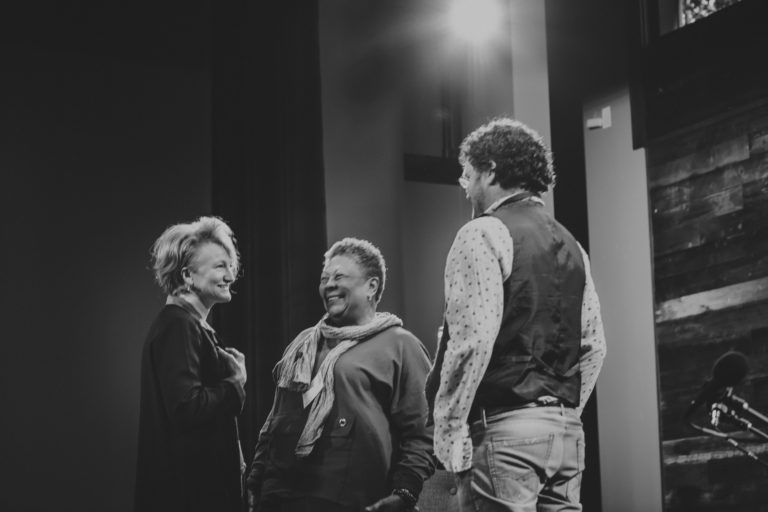
Pádraig Ó Tuama and Marilyn Nelson are beloved teachers to many; to bring them together was a delight and a balm. Nelson is a poet and professor and contemplative, an excavator of stories that would rather stay hidden yet lead us into new life. Ó Tuama is a poet, theologian, conflict mediator, and the host of our new podcast, Poetry Unbound. Together, they venture unexpectedly into the hospitable — and intriguingly universal — form of poetry that is prayer.
You can listen to the audio or read the transcript here:

https://onbeing.org/programs/padraig-o-tuama-and-marilyn-nelson-a-new-imagination-of-prayer

A couple of excerpts:

Pádraig Ó Tuama: “So let us pick up the stones over which we stumble, friends, and build altars. Let us listen to the sound of breath in our bodies. Let us listen to the sounds of our own voices, of our own names, of our own fears. Let’s claw ourselves out from the graves we’ve dug. Let’s lick the earth from our fingers. Let us look up and out and around. The world is big and wide and wild and wonderful and wicked, and our lives are murky, magnificent, malleable, and full of meaning. Oremus. Let us pray."
Marilyn Nelson: In my intuition, prayer is less speaking than it is listening. And I feel that my deepest experiences of prayer have been experiences of shutting up and listening. A friend of mine who is a minister was at a retreat once. The whole time during the retreat, they would talk, and then they would go to their rooms and pray. He was always talking to God. And at one point, during his long talks to God, he heard a voice say, “Shut up and let me love you.”  
And that, for me, is what it is to be quiet enough to feel held, to feel the embrace of the divine, to realize that I am a part of something vaster than vast; and to feel that, to recognize that, to feel thankful for it, and to hope that by opening myself to that awareness, that I am allowing some of that to come through me.

Just Mercy

Public interest lawyer Bryan Stevenson lives in Alabama and is the founder of the Equal Justice Initiative, which works to combat injustice in the U.S. legal system. The new movie, Just Mercy, is an adaptation of his 2014 memoir of the same name. He says that the fact that his state honors Lee at all — let alone on the same day as King — is a sign that America has not acknowledged the evils of its past.

"In the American South, where I live, the landscape is littered with the iconography of the Confederacy," Stevenson says. "We actually celebrate the architects and defenders of enslavement. For me, that has to change if we're going to get to the kind of healthy place I think we need to get to."

Stevenson has traveled the world, observing how other cultures address the injustices of the past. He notes that Johannesburg has a museum and monuments that "talk about the wrongfulness of apartheid." In Berlin, he says, "You can't go 200 meters without seeing markers and stones placed next to the homes of Jewish families that were abducted during the Holocaust."

"But in this country," he says, "we don't have institutions that are dedicated and focused to making sure a new generation of Americans appreciates the wrongfulness of what we did when we allowed lynching to prevail and persist, what we did when we created racial apartheid through segregation."

In 2018, Stevenson and his organization opened the Legacy Museum and the National Memorial for Peace and Justice in Montgomery, Ala., both dedicated to the legacy of slavery, lynching, segregation and mass incarceration in the U.S. For Stevenson, the museum and the monument are an effort to address the past — and to change the future.

"I just felt like we had to introduce a narrative about American history that wasn't [being] clearly articulated," he says. "We need to create institutions in this country that motivate more people to say 'Never again' to racial bias and bigotry."


You can listen to it here or read excerpts here:

https://www.npr.org/2020/01/20/796234496/just-mercy-attorney-asks-u-s-to-reckon-with-its-racist-past-and-present


Feb. 9 Sermon (Epiphany 5)

O God, as salt poured from its shaker flavors our food, by your Spirit, set us free from our attachments to the safe containers, at times confinements, of our existence. Send us out to season your world with your love. In our loving, let us be as light that dispels the shadows of injustice. As salted light, may all whose lives we touch know that you create us holy and call us to become whole. Amen.

You are the salt of the earth; but if salt has lost its taste, how can its saltiness be restored? It is no longer good for anything, but is thrown out and trampled under foot.

Salt - sodium chloride (NaCl) – It is essential for life and saltiness is one of the basic human tastes. Salt is one of the oldest food seasonings, and is an important method of food preservation. (Wikipedia)

Jesus is using the image and symbol of salt as way of talking about our faith. Jesus expects us to live our faithful lives for the salt that is already inside us because if we don’t, we lose the flavor, the taste, and our faith & lives become no longer good for anyone or anything.

"It is not so much that salt ceases to be salt, but it becomes contaminated by additions over time, dirt, stones, etc, so that it becomes useless... In the context salt is an image of integrity and wholeness..." (William Loader, Murdoch University, Uniting Church in Australia)

We are live to salty, faithful lives. But we also know that if there is too little salt or too much salt, it will ruin a dish. To live faithful lives, our salt needs to be balanced & whole…

Once there was a small monastery led by a very wise abbot. A young man, who had recently entered the monastery, was having a hard time adjusting to the monastic life. He was constantly complaining and criticizing. The older monks of the community had grown tired of his constant whining and went to the abbot with their concerns about the young novice.

One morning the abbot sent the novice to fetch some salt. When the novice retuned, the abbot instructed the unhappy monk to put the salt in a glass of water and drink it. The novice did as he was instructed. "How does it taste?" the abbot asked. "Bitter!" spit the novice.

The abbot smiled. "Get some more salt and follow me."

The abbot and the novice, clutching another handful of salt, walked to a small lake near the monastery. "Throw the salt into the lake." Again, the novice did as the abbot asked. "Now," Father Abbot said, "take a drink from the lake."

As the water dripped down the young man's chin, the abbot asked, "How does it taste?"

"Sweet and clean," the young man, said wiping his mouth on his sleeve.

"Do you taste the salt?" "No," the novice said.

The abbot sat next to the serious young man - who so reminded the abbot of himself many years before - and explained, "Brother, the pain of life is pure salt; no more, no less. The amount of pain in life remains exactly the same. But the bitterness we taste depends on the container we put the pain in. So when you are in pain, when you hurt, when you feel broken, the only thing you can do is enlarge your sense of things. Stop being a glass. Become a lake."

In the Gospel today, Jesus enlarges the disciples understanding of their role in the world. You are salt of the earth. The wise Abbott helps a young novice notice how his salt can be so bitter when it is just himself, his glass, but when his vision is enlarged, it moves away from bitterness, he becomes a lake and his salt is added to others. We must balance our lives so what people taste enhances them and our world.

Molly Birnbaum is editor-in-chief of America’s Test Kitchen Kids and knows that kids cooking can enrich our world. Her company develops recipes and resources to make the kids in the family part of not just the meal but the preparation of the meal. Birnbaum writes in TIME Magazine [December 16, 2019] that cooking is not just an “art form” but a “way of teaching vital 21st century skills, such as critical thinking, creativity and collaboration. It invites kids to make connections to the broader world by asking Where does our food come from? and What is the history of this recipe? And it allows them to apply what they are learning in school in a new context.”

"Cooking also brings science concepts to life. Take mayonnaise, for example. At another recent session, after adding egg yolks, lemon juice, mustard, sugar and salt to the bowl of a food processor, the kids slowly added oil to the running food processor, creating a creamy, smooth mayo. Well, some of them did. Others went rogue and added the oil all at once, leaving behind a broken, greasy mess. It was a perfect opportunity for them to learn that oil and water don’t usually mix and how an emulsion gets the two to play nicely–if you add the oil a little bit at a time. Recipe failures like this matter as much as the successes, as they help kids develop resilience."

But most important of all, Birnbaum believes, cooking enables kids to experience “the joy of sharing the food [they make] with others, from muffins for [your friends] to cookies for [the] soccer team” Cooking “encourages kids to work with others to produce the final result and boost their confidence as they take the lead in packing their own lunches, baking holiday treats or helping to get dinner on the table. It also encourages them to be open to foods they otherwise might not have tried.”

“Cheesy as this might sound,” Molly Birnbaum writes, “it’s the memories you make together in the kitchen.” This past Christmas, Molly and her daughter Olive — who’s only three — did a lot of holiday baking, including Olive’s favorite chocolate-chip cookies. “Yes, it required that I keep an extra set of clothes (for each of us) nearby,” Mom says, “but if [Olive] remembers the moment she realized that sneaking bites of dough is both acceptable and delicious, I will happily forget the mess that accompanied that experience.”

Jesus calls all who would be his disciples to live into their saltiness for our hungry world, how to master the art of bringing out the flavor and richness of compassion, mercy, peace and forgiveness in our lives and the lives of those we love. As Molly Birnbaum writes, it’s a matter of possessing not just the skills of cooking but the attitude of joy and fulfillment in doing for others, of working together, of daring to be messy and willing to try to new things for the sake of bringing the love of God to life.

May we listen to Jesus' challenge to be salt in our world today: to make God's presence and grace realities, to season our own time and place; illuminating the shadows, those hopeless corners of our world with justice and hope. So that all whose lives we touch know that you create us holy and call us to become whole in God’s name. Amen.

Saturday, February 1, 2020

Candlemas with Rowan Williams

“For God’s love there is never any person or situation beyond its reach. There are no insiders and outsiders. There only those for whose company and well-being, God is eternally, firerally, passionate. Into that love, we step, in silence and in hope, tonight.” Rowan Williams 2016