In 2008, Human Rights Day (December 10) marks the 60th anniversary of a world-changing event. On December 10, 1948, amid the smoldering ashes of World War II, the brave voices of the newly formed United Nations proclaimed the Universal Declaration of Human Rights, calling for “the advent of a world in which human beings shall enjoy freedom of speech and belief and freedom from fear and want…”
In the ensuing 60 years, the Universal Declaration “transformed the language and texture of international relations, gave legitimacy to anti-colonial movements, inspired a new form of activism and helped bring down totalitarian regimes,” according to Harvard law professor and Catholic theologian Mary Ann Glendon. A World Made New, Glendon’s 2001 book, drew its title from the nightly prayer of former First Lady Eleanor Roosevelt, who chaired the drafting of the Declaration. Mrs. Roosevelt was a member of St. James’ Episcopal Church, Hyde Park, New York.
All of the world’s major religions helped to craft the Declaration, which recognizes and defines a broader range of rights than those mentioned in the Magna Carta, the Declaration of Independence, and the French Declaration of the Rights of Man. In a departure that foreshadowed the pronouncements of Vatican II 17 years later, the Roman Catholic Church joined the World Council of Churches and the Lambeth Conference in endorsing the Declaration’s provisions on religious freedom, arguably one of the world’s oldest human rights concepts. The Bible tells us in the Book of Ezra that “the Lord stirred up the spirit of Cyrus, king of Persia, so that he made a proclamation throughout all his kingdom and also put it in writing…”
This proclamation, inscribed in Babylonian cuneiform on a clay cylinder discovered by archaeologists in 1879, set out a policy of religious toleration and promoted the material well-being of conquered peoples. A replica of the cylinder commands a place of honor in the United Nations headquarters in New York.
In the ensuing 60 years, the Universal Declaration “transformed the language and texture of international relations, gave legitimacy to anti-colonial movements, inspired a new form of activism and helped bring down totalitarian regimes,” according to Harvard law professor and Catholic theologian Mary Ann Glendon. A World Made New, Glendon’s 2001 book, drew its title from the nightly prayer of former First Lady Eleanor Roosevelt, who chaired the drafting of the Declaration. Mrs. Roosevelt was a member of St. James’ Episcopal Church, Hyde Park, New York.
All of the world’s major religions helped to craft the Declaration, which recognizes and defines a broader range of rights than those mentioned in the Magna Carta, the Declaration of Independence, and the French Declaration of the Rights of Man. In a departure that foreshadowed the pronouncements of Vatican II 17 years later, the Roman Catholic Church joined the World Council of Churches and the Lambeth Conference in endorsing the Declaration’s provisions on religious freedom, arguably one of the world’s oldest human rights concepts. The Bible tells us in the Book of Ezra that “the Lord stirred up the spirit of Cyrus, king of Persia, so that he made a proclamation throughout all his kingdom and also put it in writing…”
This proclamation, inscribed in Babylonian cuneiform on a clay cylinder discovered by archaeologists in 1879, set out a policy of religious toleration and promoted the material well-being of conquered peoples. A replica of the cylinder commands a place of honor in the United Nations headquarters in New York.
But the Universal Declaration goes well beyond a proclamation of tolerance. Article 18 asserts that all persons have “the right to freedom of thought, conscience and religion” including the right to change their religion or belief, and the freedom to manifest their beliefs in public through “teaching, practice, worship and observance.”
The 1981 UN Declaration on the Eli-mination of All Forms of Intolerance and of Discrimination Based on Religion or Belief refined these concepts further to include the right of religious communities to choose lay and ordained leadership according to their own criteria.
In the United States, this right is buttressed by a legal tradition that also guarantees the right of individuals to serve in any capacity for which their religious community deems them qualified. The government may not interfere, and it is unlawful for private citizens or other religious groups to collaborate across state lines to frustrate the free exercise of these rights and other constitutionally protected activities.
In practical terms for the Episcopal Church, this means that a bishop or senior warden, for instance, has a constitutional as well as an ecclesiastical right to serve in that capacity if the church has authorized it, and the church has a constitutional right to authorize it. Persons not bound by the constitution and canons of the Episcopal Church, therefore, may not interfere with the exercise of these rights.
Promoting respect for religious freedom and other human rights on the American scene is integral to advancing their realization in lands where they are fragile or non-existent. Human Rights Day commemorates the creation of a blueprint for a world where mercy and truth meet, where righteousness and peace kiss—a world that does not yet exist. Yet the epistle for December 7 reminds us “with the Lord one day is like a thousand years, and a thousand years are like one day.” As we watch and wait and prepare for the Advent of our Lord, let us pray that this hope for a world made new might become a lived reality.
Article by Donn Mitchell. He is editor of The Anglican Examiner, an on-line magazine of religion and public affairs, at www.AnglicanExaminer.com.The 1981 UN Declaration on the Eli-mination of All Forms of Intolerance and of Discrimination Based on Religion or Belief refined these concepts further to include the right of religious communities to choose lay and ordained leadership according to their own criteria.
In the United States, this right is buttressed by a legal tradition that also guarantees the right of individuals to serve in any capacity for which their religious community deems them qualified. The government may not interfere, and it is unlawful for private citizens or other religious groups to collaborate across state lines to frustrate the free exercise of these rights and other constitutionally protected activities.
In practical terms for the Episcopal Church, this means that a bishop or senior warden, for instance, has a constitutional as well as an ecclesiastical right to serve in that capacity if the church has authorized it, and the church has a constitutional right to authorize it. Persons not bound by the constitution and canons of the Episcopal Church, therefore, may not interfere with the exercise of these rights.
Promoting respect for religious freedom and other human rights on the American scene is integral to advancing their realization in lands where they are fragile or non-existent. Human Rights Day commemorates the creation of a blueprint for a world where mercy and truth meet, where righteousness and peace kiss—a world that does not yet exist. Yet the epistle for December 7 reminds us “with the Lord one day is like a thousand years, and a thousand years are like one day.” As we watch and wait and prepare for the Advent of our Lord, let us pray that this hope for a world made new might become a lived reality.
Resources:
Full text of the Declaration and translations: www.unhchr.ch/udhr/
U.S. State Department Report on International Religious Freedom: www.state.gov/g/drl/rls/irf/2007
UN High Commissioner for Human Rights: www.ohchr.org/english/
Episcopal Public Policy Network: www.episcopalchurch.org/eppn.htm
Prayers:
O Holy God, you love righteousness and hate iniquity: Strengthen, we pray, the hands of all who strive for justice throughout the world, and, seeing that all human beings are your offspring, give aid to those who promote the dignity and freedom of every person; through Jesus Christ the Liberator, who lives and reigns with you and the Holy Spirit, one God, for ever and ever. Amen.
Almighty God, who created us in your own image: Grant us grace fearlessly to contend against evil and to make no peace with oppression; and, that we may reverently use our freedom, help us to employ it in the maintenance of justice in our communities and among the nations, to the glory of your holy Name; through Jesus Christ our Lord, who lives and reigns with you and the Holy Spirit, one God, now and for ever. Amen.


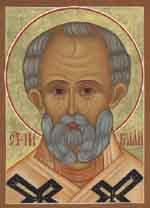 The story of St. Nicholas offers a possible way of dealing with the "Santa Claus" problem, to parents who do not want to lie to their children, even in fun, but do not want to say simply: "Bah, humbug! There is no such thing as Santa. Forget about him."
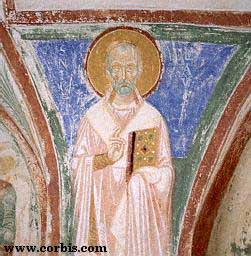 Pictures of Nicholas often show three bags of gold next to him, and often these bags have become simply three disks or balls. Nicholas became the patron of an Italian city (I think Bari, which is where his body is now buried) that was a center of the pawnbroking business, and hence a pawnbroking shop traditionally advertises by displaying three gold balls over its front. It is thought that some persons looking at pictures of Nicholas confused the three round objects with human heads. Hence there is a story of a wicked innkeeper who murdered three boys and salted their bodies to serve to his guests, to save on the butcher's bill. Nicholas visited the inn and confronted the innkeeper, who confessed his crime, whereupon Nicholas prayed over the brine-tub and the three boys leaped out unharmed. Other stories have him saving the lives of three innocent men who had been condemned to death. Still other stories have him coming to the rescue of drowning sailors (could this be related to the brine-tub incident?). Nicholas has always been popular with children, mariners, pawnbrokers, the Dutch, the Russians, and recently, the department-store owners. (American readers may remember the story of the brine-tub through reading it as children in the book The Dutch Twins, by Lucy Fitch Perkins, author of The Spanish Twins, The Italian Twins, and many similar books, all children's favorites in the middle of this century. They may now be banned as politically incorrect -- I have no idea. If your children know the brine-tub story, from this book or elsewhere, they may be interested to know how it may have originated.)